
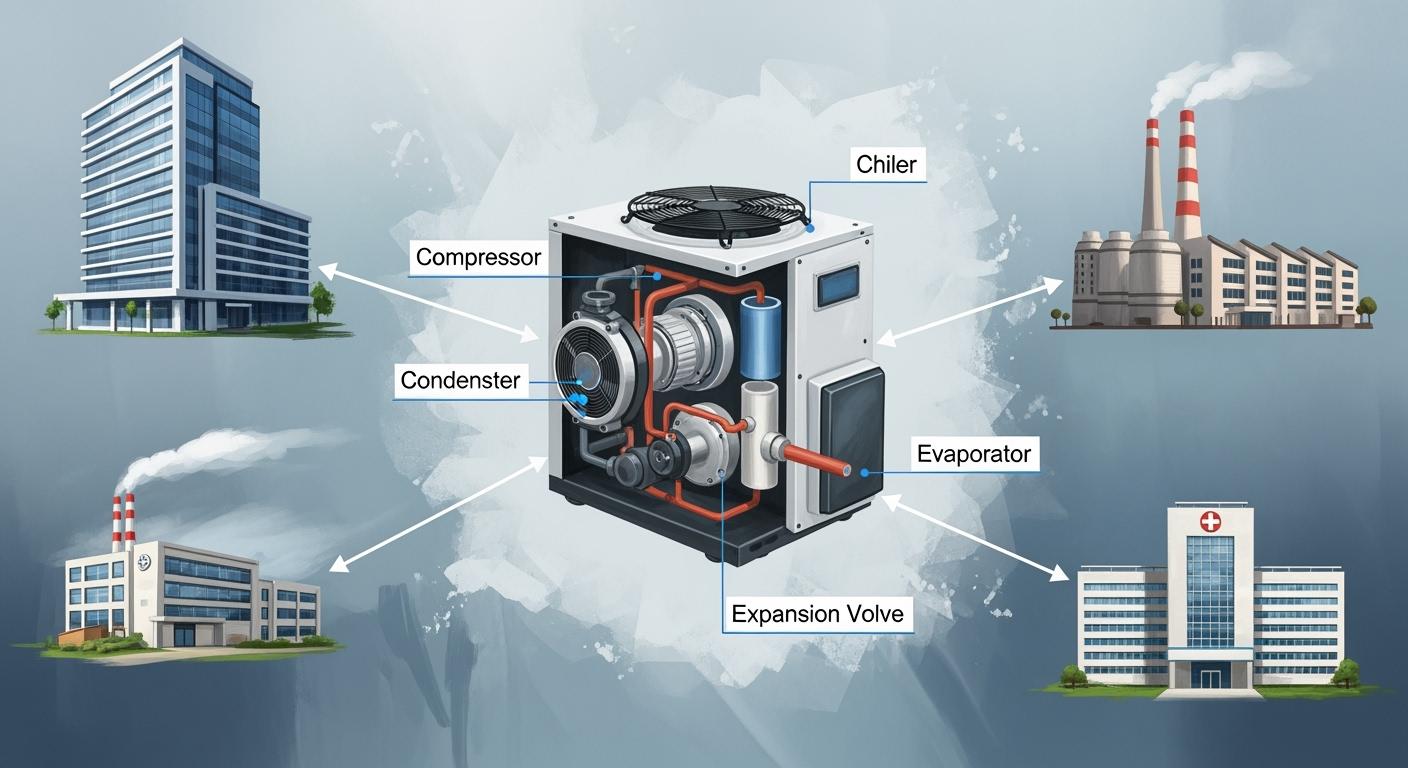
You should know that different chillers have special chiller components for their jobs. Picking the right parts helps save energy and money. For example, expansion valves control refrigerant flow and keep temperatures steady. This helps the system work better. Advanced features like high-efficiency compressors and smart controls use less energy. They also help the equipment last longer. If you know how each part works, you can pick the best system for you.
What Are Chillers?
Chiller Definition
Chillers help keep things cool. People use chillers in many buildings and factories. They make rooms and machines comfortable and safe. Chillers take heat away from water or other liquids. The cold liquid moves through pipes to cool air or machines.
A water-chilling package is built in a factory. It cools water with a vapor compression refrigeration cycle. This system gives you cooling and heating when needed. It works well and is good for the environment.
There are different kinds of chillers. Each kind has special parts for its job. Some chillers use air to cool the liquid. Others use water or both air and water. You pick the best chiller for your needs and space.
Chiller Applications
You can find chillers in lots of places. Hospitals, factories, and data centers use them. Chillers keep people and machines safe and cool. Here are some ways chillers are used:
MRI and CT scanners need chillers to stay cool and work right.
Laboratories use chillers to keep tools at the right temperature.
Blood banks use chillers to store blood safely.
Pharmaceutical plants use chillers to control drug making temperatures.
Data centers use chillers to cool servers and protect data.
Hospitals use chillers for operating rooms and patient comfort.
Manufacturing plants use chillers for process cooling and saving energy.
Some chillers have smart controls and can be changed easily. These features help save energy and fit new needs. Some chillers use natural refrigerants to help the environment. Others use liquid cooling or hybrid systems for better results.
When you pick a chiller, think about your space, energy use, and cooling needs. The right chiller gives you good and steady cooling for your job.
Main Components of a Chiller

When you look at chiller components, you see that each part does something important. These parts work together to keep the system cool and working well. If you know about the main parts of a chiller, you can pick the best one for your needs.
Compressor
The compressor is like the heart of the chiller. It moves the refrigerant by making a pressure difference. You find the compressor between the evaporator and condenser. This part starts the cooling cycle and keeps things running well.
The compressor pushes refrigerant through the chiller.
It helps the refrigerant change from a low-pressure gas to a high-pressure gas.
There are different types of compressors. These are centrifugal, screw, scroll, and reciprocating. Each type has good and bad points.
Here is a table to help you compare the main types of compressors:
Type of Compressor | Advantages | Disadvantages |
|---|---|---|
Reciprocating Compressors | Lower cost at first, flexible design, good control with more units | Not as energy efficient, needs more care, not good for big changes in capacity |
Centrifugal Compressors | Works well at full power, small size, fewer moving parts | Not as good when not at full power, can have surging problems, needs special parts |
Rotary-Screw Compressors | Works best when not always at full power, costs less to run | Costs more to buy, not good if you do not need to change capacity |
If you use a centrifugal chiller, you get good efficiency and a small size. You should pick the compressor that fits your cooling needs and budget.
Condenser
The condenser takes heat from the refrigerant and sends it outside. This step is important for keeping your chiller working well.
Shell and tube condensers are best for factories with steady water.
Plate condensers are good for small chillers where space and cost matter.
Air condensers are best for places without water systems.
Tip: The condenser helps your chiller last longer by removing extra heat.
Evaporator
The evaporator cools the water or liquid in your chiller. It takes heat from the liquid, making the refrigerant boil and turn into vapor.
The evaporator takes heat from the chilled water.
Shell and tube designs are common. The tubes hold water, and the shell holds refrigerant.
The refrigerant goes in as a liquid and leaves as a vapor, ready for the compressor.
You need a good evaporator to keep your cooling strong and steady.
Expansion Valve
The expansion valve controls how much refrigerant goes into the evaporator. It keeps the flow right for how much cooling you need.
Thermostatic Expansion Valves (TXV) change flow based on cooling needs.
Automatic Expansion Valves (AXV) keep the pressure steady in the evaporator.
Float Valves keep the liquid level the same.
Pilot-Operated Expansion Valves (POE) give you good control for changing loads.
The right expansion valve protects your compressor and helps your chiller last longer.
Power Panel and Controls
The power panel and controls help you run your chiller safely and well. New systems use smart controls to save energy and adjust to your needs.
Advanced controls use sensors and AI to manage your chiller.
You can check how your chiller is working and find problems early.
Smart panels can help you save up to 20% on energy compared to old systems.
Water Box
The water box connects the chiller to your water pipes. It sends water in and out of the evaporator and condenser.
The water box makes cleaning and fixing easier.
It helps keep water flow steady and stops leaks.
A strong water box keeps your chiller running without problems.
Secondary Components
There are other chiller components that help the main parts. These are the receiver and oil separator.
The receiver holds extra refrigerant and helps balance the system.
The oil separator takes oil out of the refrigerant vapor. It uses baffles and screens to catch oil drops and send them back to the compressor.
In compressors that use oil, an air/oil separator takes out oil after the compressor. This keeps your chiller clean and working well.
Note: If you take care of these extra chiller parts, your chiller uses less energy, breaks down less, and lasts longer.
If you keep all your chiller parts in good shape, your chiller works better and costs less over time.
Types of Chillers
You can pick from different chillers for cooling. Each kind works best in certain places. They use special parts to do their job.
Air-Cooled Chillers
An air-cooled chiller uses fans to move air over coils. This cools the refrigerant and takes heat away. You often see these chillers outside or on rooftops.
Air-cooled chillers are simple to set up and take care of. You do not need water or a cooling tower.
Air-cooled chillers are used in many places. Factories use them to keep machines cool. Offices, malls, and hotels use them for air conditioning. Data centers use them to keep servers safe. HVAC systems use them to cool buildings.
Air-cooled chillers are good for small and medium buildings. They need more space outside for air to flow. The temperature changes with the weather. They may use more energy when it is hot.
Water-Cooled Chillers
A water-cooled chiller uses water to cool the refrigerant. The system sends hot water to a cooling tower. The heat goes into the air.
Water-cooled chillers save more energy and last longer. They are quiet and work well in big buildings.
You see water-cooled chillers in hospitals and factories. Big office towers use them too. These chillers need more space and cost more to put in. They use extra parts like pumps and cooling towers. You must treat the water to keep it clean.
Main Differences Between Air-Cooled and Water-Cooled Chillers
Feature | Air-Cooled Chillers | Water-Cooled Chillers |
|---|---|---|
Installation Requirements | Needs outdoor space for airflow | Needs cooling towers and more indoor space |
Efficiency | Less efficient, depends on outdoor temp | More efficient, lower condensing temperatures |
Maintenance | Easier, fewer parts | More complex, needs water treatment |
Operational Costs | Higher, uses more energy | Lower, saves energy over time |
Water-cooled chillers use less energy than air-cooled chillers.
Air-cooled chillers cost less and are easier to fix.
Water-cooled chillers last longer and make less noise.
Evaporative Condensed Chillers
Evaporative condensed chillers spray water over coils to cool the refrigerant. The water turns into vapor and takes heat away. This lowers the temperature and saves energy.
You find these chillers in factories and HVAC systems. Many factory jobs use them.
Evaporative condensed chillers use less energy than air-cooled chillers. They work well where water is easy to get. You see them in big factories and places that need steady cooling.
When you choose a chiller, think about your space and budget. Each type has special parts and works best for certain jobs.
Chiller Components Compared
Air-Cooled vs. Water-Cooled
When you look at air-cooled and water-cooled chillers, you see they are very different. Air-cooled chillers use fans to blow air over coils. This cools the refrigerant and takes away heat. Water-cooled chillers use water to move heat away. The water goes to a cooling tower and lets the heat out into the air.
Air-cooled chillers are simple to put in. You do not need a cooling tower or extra pumps. These chillers take up less space and work well outside. You can set them up fast, and they are good for places with little water. But air-cooled chillers use more energy. They have to work harder when it is hot, so they cost more to run.
Water-cooled chillers use water to move heat. This makes them use less energy. They cool better in big buildings or factories. You need more parts, like cooling towers and pumps. It costs more to set them up, and you must keep the water clean. These chillers last longer and are quiet, but you pay more to take care of them.
Here is a table to help you compare the two types:
Performance Metric | Air-Cooled Chillers | Water-Cooled Chillers |
|---|---|---|
Cooling Method | Uses ambient air for heat exchange | Relies on water for heat exchange |
Energy Efficiency | Generally less efficient, higher energy use | More efficient due to better heat transfer |
Installation Requirements | Requires less space, easier to install | Needs cooling towers and pumps, more complex |
Maintenance | May require more frequent maintenance | Higher maintenance costs due to water treatment |
Operating Costs | Higher due to fan energy consumption | Lower initial costs but higher long-term costs |
Tip: If you want something easy and have little space, pick an air-cooled chiller. If you want to save energy and can use water systems, a water-cooled chiller might be better.
Compressor Types (Reciprocating, Centrifugal, Screw)
The compressor is a very important part of a chiller. You can choose from different types. The main types are reciprocating, centrifugal, and screw compressors.
Reciprocating Compressors use pistons to move refrigerant. They have lots of moving parts. You need to check them often and keep them oiled. These compressors are best for small or medium jobs. They cost less at first but need more care.
Centrifugal Compressors use spinning wheels to move refrigerant. They have fewer moving parts, so you do not need to check them as much. These compressors are good for big buildings or factories. They save energy and give steady cooling. If they break, you may need an expert to fix them.
Screw Compressors use two screws that spin to move refrigerant. They are best for big jobs and can handle changes in cooling. These compressors need less care, but a specialist should check them sometimes.
Here is a table to help you see the differences:
Compressor Type | Efficiency | Capacity | Maintenance Requirements |
|---|---|---|---|
Reciprocating | Lower efficiency for continuous use | Intermittent air demand | Requires frequent maintenance (piston rings, valves) |
Centrifugal | High efficiency for continuous use | Continuous air supply for large-scale industries | Less frequent but specialized maintenance needed |
Screw | Best energy-to-power ratios | Suitable for large-scale industries | Less routine maintenance, more specialized care |
Reciprocating compressors need lots of checks because they have more parts.
Centrifugal compressors need less care, but fixing them can be hard.
Screw compressors save energy and do not need much daily care.
Note: If you want less work, pick a centrifugal or screw compressor. If you want to spend less at first, a reciprocating compressor could be good.
Mechanical vs. Absorption Chillers
You can also pick between mechanical and absorption chillers. These two types cool water in different ways.
Mechanical chillers use mechanical energy. The compressor makes the refrigerant pressure go up. This needs electricity or another power source. Most buildings and factories use mechanical chillers. They are good when you need steady and strong cooling.
Absorption chillers use heat energy instead of mechanical energy. They use a special process where the refrigerant vapor mixes with an absorbent. A pump moves this mix to a higher pressure. This uses very little electricity. Absorption chillers often use waste heat or steam from other machines. This is good if you want to save electricity or use extra heat.
Absorption chillers are smaller because they put many parts together. You do not need a compressor, so they are quiet. But absorption chillers may not cool as fast as mechanical chillers.
If you have extra heat from another machine, an absorption chiller can help you save energy. If you need fast and steady cooling, a mechanical chiller is a better choice.
Applications by Chiller Type
Industrial Uses
Chillers are used in many industries. They help machines and products stay cool. You use chillers for different jobs:
Cooling processes in factories
Keeping food cold in freezer rooms
Treating water in plants
Making chemicals in chemical plants
Processing food and brewing drinks
Making medicines in pharmaceutical plants
Processing milk in dairy plants
Cooling tools in labs and misting machines
Cooling batteries in electric cars
Cooling grapes in vineyards and wineries
Most factories use vapor-compression or vapor-absorption chillers. You choose air-cooled or water-cooled chillers based on your space and cooling needs. Some factories use direct expansion chillers for quick cooling. Others use closed circuit systems for safety and control.
Tip: If you work in a factory, pick a chiller that fits your job and saves energy.
Commercial and Residential
Chillers are found in many buildings. They help people stay comfortable and protect equipment. The chiller you pick depends on building size and what you need to cool.
Application Area | Chiller Type | Description |
|---|---|---|
Commercial Buildings | Air and Water | |
Data Centers | Air and Water | Chillers keep servers and computers safe from heat. |
Food and Beverage Storage | Water | Chillers keep food safe during storage and transport. |
Medical and Research Facilities | Water | Chillers keep lab tools and samples cool. |
Pharmaceuticals | Water | Chillers help make and store drugs safely. |
Automotive Industry | Air | Chillers cool paint booths and test car parts. |
Air-cooled chillers are good for small buildings. Water-cooled chillers work better for big spaces or steady cooling.
Specialized Applications
Some jobs need special chillers. These are used where temperature control is very important.
Industry/Application |
|---|
Semiconductor Manufacturing |
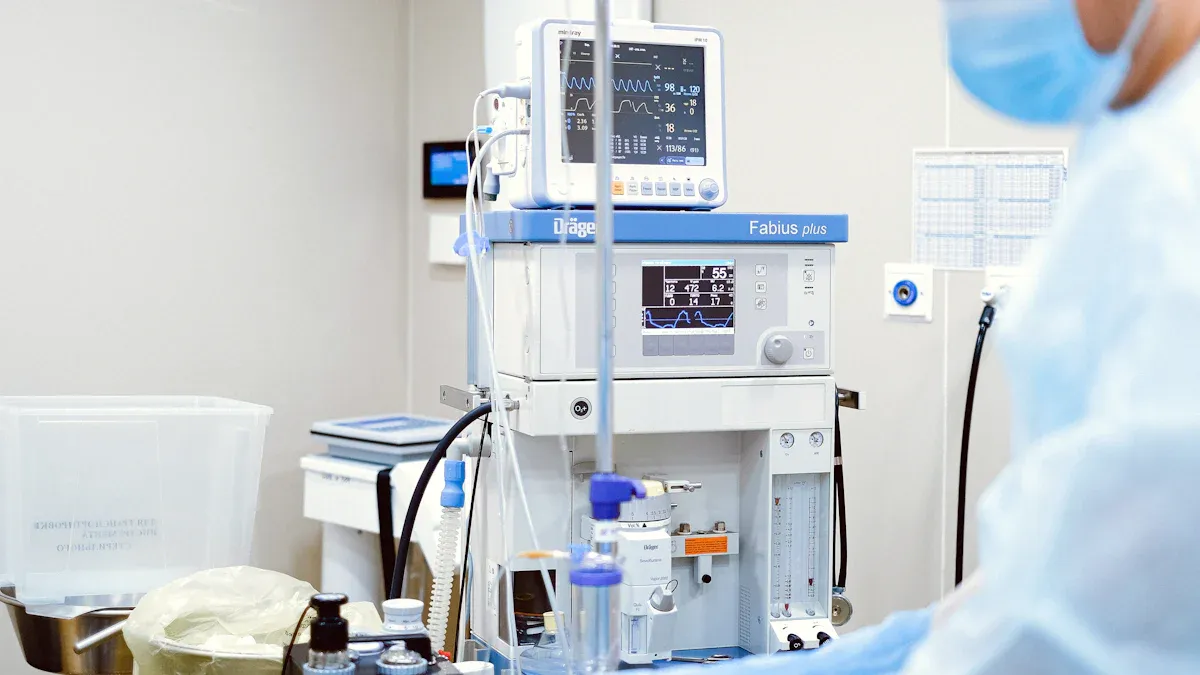
Chillers cool MRI and CT scanners in hospitals. They also keep machines cool in semiconductor factories. These chillers often have custom controls and extra safety features.
Note: If you work in a special field, you may need a chiller with special parts or settings.
Choosing Chiller Components
Key Selection Factors
When you choose chiller components, you need to think about several important factors. Picking the right parts helps your system work well and last longer. Here are the main things you should check:
Desired coolant temperature
You need to know the temperature you want for your coolant. Measure the temperature at the inlet. This helps you keep heat gain low as the coolant moves through pipes.Heat load
Find out how much heat you need to remove. You can measure this in BTUs per hour or watts. If you know your heat load, you can pick a chiller that cools enough for your job.Coolant flow and pressure
Make sure the coolant flows at the right speed and pressure. If the flow is too high or too low, your equipment might not cool well or could get damaged.Condenser heat dissipation
Decide how you want to get rid of the heat. You can use air-cooled or water-cooled systems. Each one works best in different places.
You should also think about:
The highest room temperature where you will put the chiller
How much heat the chiller itself gives off
Space for the chiller and its parts
Other requirements, such as remote temperature tracking
Safety standards for your building or factory
Tip: Always check the size and location before you buy. A chiller that is too big or too small will not work well.
Matching Components to Needs
You need to match chiller components to your cooling needs and your space. Different jobs and industries need different chillers. Look at the table below to see which type fits your situation:
When to Use | Benefits | |
|---|---|---|
Standard Chillers | Steady cooling, mild climate, basic requirements | Fast setup, lower cost, simple design |
Custom Chillers | Changing loads, tough conditions, special rules | Custom fit, better performance, saves energy over time |
Think about these points when you match components:
What do you need to cool? (water, oil, or special fluids)
How much heat does your process make?
How much space do you have for the chiller?
Do you need to save energy?
Does your job need special controls or safety features?
If you match the right components to your needs, your chiller will work better and cost less to run. You will also avoid problems and keep your equipment safe.
There are big differences in how chiller systems work. The table below helps you compare water-cooled chillers to other types. Water-cooled chillers are very efficient and easy to control. They are used in large buildings that need steady cooling. People pick water-cooled chillers for quiet use and long life. You should look at size, location, safety, and temperature control before choosing. Follow these steps to find the best chiller system for you:
Find out how fast water moves in your water-cooled chiller.
Check how much heat goes into your water-cooled chiller.
Figure out how much the temperature changes in your water-cooled chiller.
Your chiller system works better if you check technical needs, costs, and environmental rules. Always look at what you need before picking a chiller system or water-cooled chiller.
Aspect | Compression Chiller System | Absorption Chiller System |
|---|---|---|
Drive | Electric motor | Heat energy |
Core Parts | Compressor, condenser | Evaporator, absorber |
~4.0 | 0.6–1.2 | |
Response | Fast | Slow |
Capacity Range | Small to large | Large-scale only |
Energy Source | Electricity | Steam, hot water |
Applications | HVAC, labs | Central cooling |
Cost | Lower | Higher |
Tip: Your chiller system works best when you match the water-cooled chiller to your space and cooling needs.