
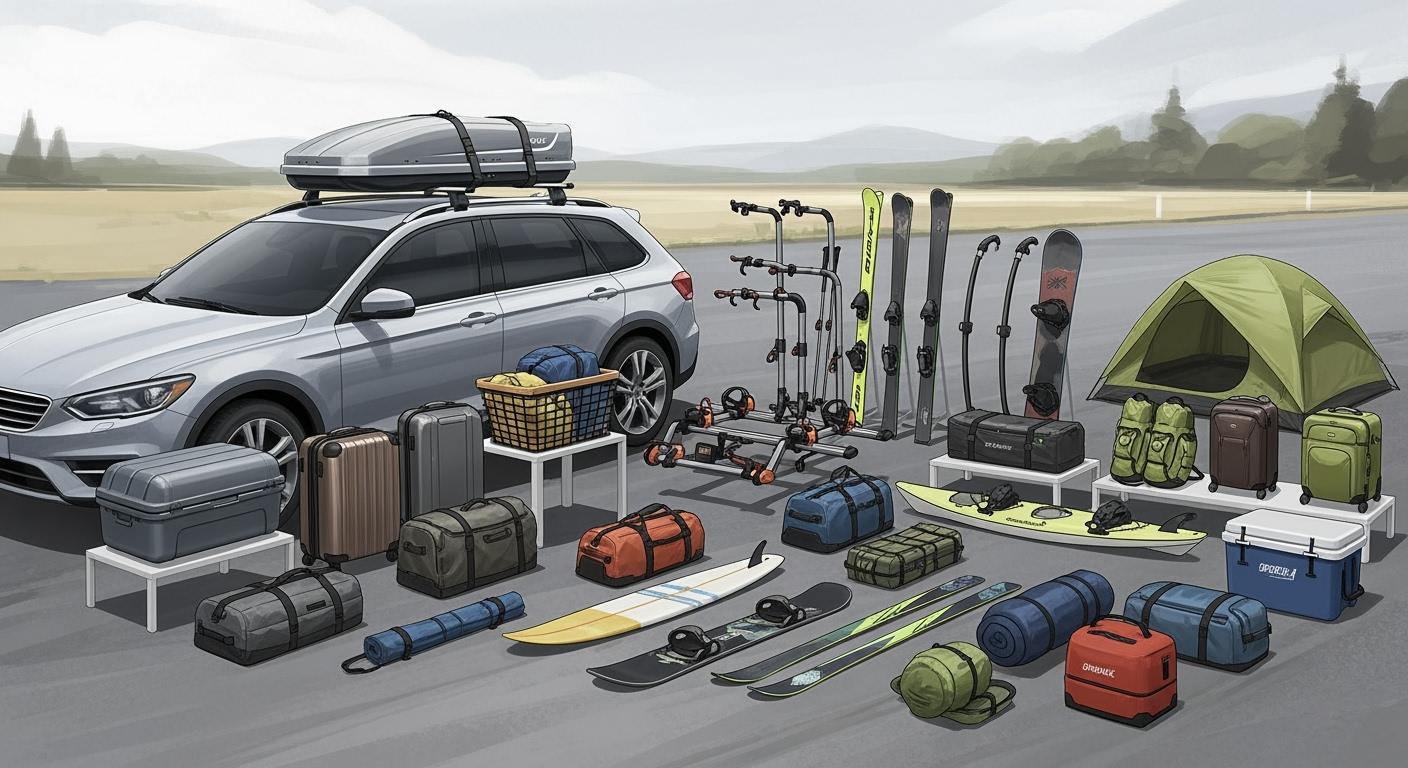
When you pick a roof pack, think about your car. Also, think about what you want to carry. Your car’s roof type is important. How much weight it can hold matters too. The size of your cargo is also important. The table below lists key things to think about. You need a roof pack that fits your needs. It should also keep your things safe.
Factor | Description | Why It’s Critical |
|---|---|---|
Vehicle Type | Roof structure, mounting points, load capacity | Makes sure it fits and works right |
Existing Rack System | Accessory compatibility, mounting hardware | Lets you install it the right way |
Intended Use | Type of accessory for safe transport | Matches what you want to carry |
Vehicle Load Capacity | Total weight of rack, accessory, and cargo | Keeps your car safe |
Budget Considerations | Cost, features, durability, brand | Helps you get good value for your money |
Material & Durability | Longevity, gear protection | Makes it last longer and protects your things |
Storage Requirements | Convenience, prevents damage | Makes it easy to use and keeps it in good shape |
Vehicle & Roof Type Compatibility
Picking the right roof pack means knowing if it fits your car. Not all roof packs work with every car. You should look at your car’s roof style. Make sure the roof top rack you choose matches your car. Doing this helps you avoid problems when you install it. It also keeps you safe.
Roof Pack Fit for Your Car
Your car’s roof style tells you what roof top rack and roof pack you can use. Some cars have raised rails. Others have flush rails or no rails at all. Each roof style needs a special mounting system. The table below shows different roof styles. It also lists their good points and which racks fit best:
Roof Style | Advantages | Compatible Rack Types |
|---|---|---|
Raised Roof Rails | High versatility, compatible with a wide range of racks, easy installation | Nearly all universal roof racks, crossbars, roof boxes |
Flush Roof Rails | Sleek look, reduces wind resistance | Racks designed for flush rail systems |
Fixed Point Roof | Stable and secure, greater load capacity | Racks for fixed-point systems |
Bare Roof | Full cargo functionality despite no rails | Clamp-style or door-mounted racks |
Rain Gutter Roof | Robust mounting system, high load capacity | Racks designed for rain gutters |
Bed Rack – T Slot Roof | Excellent load-bearing capacity, versatile positioning | Racks for T-slot systems |
Tip: Always look in your car’s manual or on the maker’s website to check if a roof pack fits. This helps you avoid sending things back. It also keeps your gear safe.
Roof Top Rack Styles
There are many roof rack types for different cars. Each one has its own features and ways to install it. Here are the most common roof top rack styles:
Rain Gutters: These are on older cars and big vans. They use a simple cross bar system.
Bare Roof: This is the most common today. These need special kits made for your car.
Raised Rail: Many SUVs and minivans have these. These racks are easy to put on and do not need special kits.
Flush Rail: This is a newer style with a smooth look. These need special fit kits.
Tracks: These let you move cross bars to different spots. Some need you to drill holes.
Fixed Point: These use factory points for a neat install. You can barely see them when not in use.
You can also pick full-length baskets for more space. There are special racks for things like kayaks or bikes. Racks can be made from steel, aluminum, or composite materials. The material changes how strong and heavy your roof top rack is.
Weight Capacity & Limits
You need to know your car’s weight limits before you load your roof pack. Every car has a dynamic roof load limit and a static roof load limit. The dynamic limit is the most weight your roof can hold when you drive. The static limit is higher and is for when your car is parked. SUVs and big 4x4s can hold more than small cars.
Dynamic Roof Load Limit: This is the most weight your roof can hold when moving. It matters for roof tents and heavy things.
Static Roof Load Limit: This is the most weight your roof can hold when parked. It can be up to five times the dynamic limit. This is good for roof tents and people.
Vehicle-Specific Considerations: Always check your car’s manual for the right numbers. Do not guess.
The rack’s material and design also change how much weight it can hold. Aluminum racks can hold more than plastic ones. Wider crossbars give better support. Always follow the maker’s weight rules for each rack to stay safe.
Note: If you put too much weight on your roof pack, you can hurt your car and make driving dangerous. Always add the rack, roof pack, and cargo weight to stay under the limit.
Cargo Needs & Planning
Cargo Size and Shape
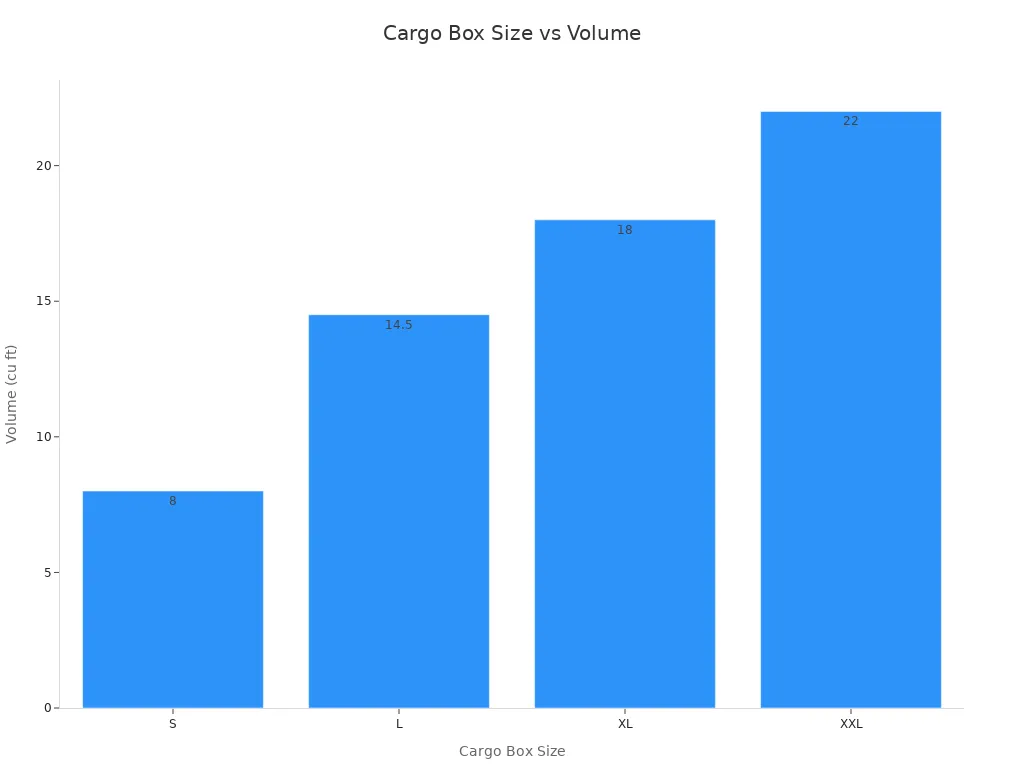
You need to think about what you want to carry on your roof pack. The size and shape of your cargo will help you pick the right roof box. Some boxes are small and fit a few bags. Others are extra large and hold gear for a big group. Look at the table below to see common cargo box sizes and what they fit best:
Cargo Box Size | Volume (cu ft / L) | Fits Roughly | Ideal For |
|---|---|---|---|
S | 8 / 300 | 3 people | Weekend getaway |
L | 13-16 / 380-450 | 4 people | Family ski or camping trip |
XL | 18 / 500 | 5 people | Larger family ski or camping trip |
XXL | 22 / 610 | 6 people | Ski trip or outdoor adventure with a large group |
You should check the load capacity of your roof pack before you buy. If you carry long or odd-shaped items, you may need a roof basket or tray. Always match the box size to your cargo considerations.
Frequency of Use
How often you use your roof pack changes what you need. If you use it every month, you should buy a strong and permanent rack. This gives you better security and lasts longer. If you use it only a few times a year, a temporary rack saves money and gives you more options.
Regular users should choose a high-quality, durable roof rack.
Occasional users may pick budget-friendly temporary options.
The type of cargo and your plans matter most.
Tip: If you use your roof rack often, the higher cost pays off with better reliability and safety.
You must also check the load capacity each time you pack your gear. This keeps your car safe and helps your roof pack last longer.
Special Items Consideration
Some items need special roof pack features. If you carry kayaks, bikes, or skis, you need racks made for those shapes. These racks hold your gear tight and keep it safe. Look at the table below to see what you need for special items:
Accessory Type | Primary Use | Key Benefit | Important Considerations |
|---|---|---|---|
Kayak/Canoe Carrier | Transport boats and paddleboards | Securely holds specific boat shapes | Specific to boat type, impacts width/height, requires careful loading |
Ski/Snowboard Carrier | Transport skis and snowboards | Keeps wet gear outside, locking options | Capacity limits, potential binding interference |
Bike Carrier | Transport bicycles | Frees up interior space, secure bike transport | Varies by type, impacts height, can cause noise |
You should always check if your roof pack fits these special racks. This helps you avoid damage and keeps your gear safe on the road.
Roof Pack & Roof Rack Guide
Choosing the Right Roof Box
You need to think about several factors when choosing the right roof box for your vehicle. The size of your car matters. Smaller cars, like sedans, can only hold compact roof packs. SUVs and vans can handle larger types. You must check your roof capacity before you buy. The amount of gear you want to carry also affects your choice. If you have a lot of luggage, you need a bigger box. Some gear, like skis, needs a longer box. If you want to mount other items on your roof, pick a narrow box to save space. Always keep clearance in mind. A tall roof pack can make it hard to park in garages or drive-thrus.
Here is a table to help you when selecting a roof box:
Factor | Description |
|---|---|
The size of your vehicle | Smaller vehicles need smaller roof packs. |
How much gear you’re trying to transport | More gear means you need a larger box. |
What type of gear you’re transporting | Long gear, like skis, needs a longer box. |
Whether you need space on your roof | Other gear on the roof means you need a narrow box. |
Keep clearance in mind | Tall boxes can limit where you park. |
You should always check your roof capacity before installing any roof pack. Most roof boxes range from 10 to over 20 cubic feet. The weight limit for roof boxes is usually between 100 and 165 pounds. Hitch cargo boxes are smaller, with a capacity of 9 to 14 cubic feet and a weight limit of about 100 pounds.
Roof Baskets vs. Roof Boxes
You have many types of roof packs to choose from. Roof boxes and roof baskets are the most popular types. Roof boxes are enclosed and keep your gear safe from rain and theft. Roof baskets are open and work well for odd-shaped items. You need to know the pros and cons of each type before you decide.
Roof boxes protect your cargo from rain and snow. You can lock them for extra security. Many users say their gear stays dry in roof boxes, even during heavy rain.
Roof baskets do not protect your gear from the weather. One user said their cargo got soaked in a basket, even with trash bags for waterproofing. Roof baskets are good for large or odd-shaped items, but you must cover your gear to keep it dry.
Roof boxes offer better security. You can lock them to keep your things safe. Roof baskets do not have locks, so you need to watch your gear.
Here is a table comparing the types and roof capacity:
Type | Load Capacity (cubic feet) | Weight Limit (pounds) |
|---|---|---|
Roof Boxes | 10 – 20+ | 100 – 165 |
Hitch Boxes | 9 – 14 | ~100 |
You should match the type of roof pack to your needs. If you want weather protection and security, choose a roof box. If you need to carry large or odd-shaped items, a roof basket may work better. Always check your roof capacity before loading any type.
Tip: If you travel in wet weather, a roof box keeps your gear dry and safe. If you need to carry bikes or kayaks, look for special types of roof packs made for those items.
Roof Top Rack Materials (Aluminum vs. Steel)
You must think about the material when you pick a roof rack guide. Aluminum and steel are the most common types. Aluminum racks are light and resist rust. Steel racks are strong but can rust if scratched. Both types last a long time. Metal racks can last 40 to 70 years with little care. They can handle hail, strong winds, and hot sun. Aluminum racks work best in tough environments because they do not rust easily. Steel racks are heavy and need more care to prevent rust.
You should check your roof capacity before you pick a material. Aluminum racks are lighter, so you can carry more gear. Steel racks are heavier, so you must subtract their weight from your roof capacity. Both types are fire-resistant and safe for outdoor use.
Note: Always check your roof pack and rack for damage before each trip. A damaged rack can lower your roof capacity and put your gear at risk.
You need to match the type and material of your roof pack to your needs. If you want a light and rust-proof rack, choose aluminum. If you need extra strength, steel may work better. Always check your roof capacity and the weight of your rack before loading your gear.
Aerodynamics & Fuel Efficiency
Roof Pack Shape & Drag
When you add a roof pack to your vehicle, you change how air moves around your car. The shape and size of the roof pack matter. A bulky roof rack or box increases the area that faces the wind. This makes your car push harder against the air. Crossbars and racks can break up smooth airflow. You get more swirling air and more resistance. Even an empty roof rack can make your car less aerodynamic.
Here is a table that shows how roof packs affect drag:
Factor | Description |
|---|---|
Frontal Area Expansion | Roof racks increase the effective frontal area by 2-4 square feet, directly increasing drag force. |
Airflow Disruption | Crossbars create turbulent air pockets, leading to chaotic airflow and increased drag. |
Coefficient of Drag Changes | Adding an empty roof rack can raise the drag coefficient from 0.25-0.30 to 0.32-0.38, a 15-25% increase. |
Wake Formation | Roof racks create a larger low-pressure area behind the vehicle, increasing wake drag. |
A streamlined roof box helps reduce drag. Rounded edges and low profiles let air move more smoothly. If you pick a tall or wide roof pack, you will notice more wind noise and resistance.
Tip: Choose a roof pack with a sleek design to help your car move through the air more easily.
Impact on Fuel Consumption
Roof packs do not just change how your car looks. They also affect how much fuel you use. You spend more money on gas when your car faces more drag. Studies show that roof racks and boxes can make your car use up to 20% more fuel. This effect gets worse when you drive fast. Heavy gear on your roof adds even more fuel use.
Roof racks can lead to an increase in fuel consumption by up to 20%.
This effect is more pronounced at higher speeds.
Additional weight from items on the roof rack further worsens fuel efficiency.
If you want to save fuel, remove your roof pack when you do not need it. You can also pack light and choose aerodynamic designs. These steps help you keep your car efficient and your trips affordable.
Security & Weather Protection
Locking Features
You want your roof pack to keep your gear safe. Thieves often target roof racks because they are easy to reach. A strong locking system helps protect your belongings. Many roof packs use tamper-proof, high-security locks. These locks resist picking, cutting, and forced entry. Some locks even have a 100 dB alarm that sounds if someone tampers with them. This loud noise scares off most thieves.
You can find locks made for special gear. For example:
MaxTrax Lock: Secures recovery boards with mounting pins and a lock.
Rooftop Tent Lock: Designed to keep rooftop tents safe.
Simple Key Locks: Easy to use. You turn the key to lock or unlock your rack.
Weather-Resistant Locks: Built to last in rain, snow, and sun.
The main goal of a roof rack lock is to make it hard for thieves to steal your gear. When you use a lock, you make it much harder for someone to take your things quickly.
Waterproofing & Durability
You need a roof pack that keeps your gear dry and safe in all weather. Manufacturers use strict waterproofing standards to test their products. These standards help make sure your roof pack can handle rain, snow, and even strong winds. Here is a table showing some common waterproofing standards:
Standard | Description |
|---|---|
D7851-25 | Design of sustainable, low-slope roofing systems |
D6622/D6622M-20 | Application of hot-applied reinforced waterproofing systems |
C836/C836M-18(2022) | High solids content, liquid-applied elastomeric waterproofing membrane |
D8463/D8463M-23 | Silyl-terminated polymer based waterproofing membrane |
Roof pack materials also matter. Elastomeric coatings flex with temperature changes and resist harsh weather. Metal racks can handle wind speeds up to 160 mph. Impact-resistant materials help protect your gear from hail and flying debris. If you choose a roof pack with these features, you get better protection for your cargo in any season.
Tip: Always check for waterproof seals and sturdy materials before you buy. This helps your gear stay dry and safe, even in extreme weather.
Shopping for Roof Racks: Budget & Features
Cost vs. Value
When you start shopping for roof racks, you will see many prices. Some racks cost less than $100, while others go over $250. The price depends on the brand, material, and features. You should not just look at the price tag. Think about what you get for your money. A low-cost rack may save you money now, but it might not last as long or protect your gear as well.
Here is a table showing the current price range for roof racks and packs:
Price (USD) | Type |
|---|---|
$60.00 | Regular Price |
$149.95 | Regular Price |
$159.96 | Regular Price |
$179.00 | Regular Price |
$239.99 | Regular Price |
$264.95 | Regular Price |
$269.95 | Regular Price |
$274.95 | Regular Price |
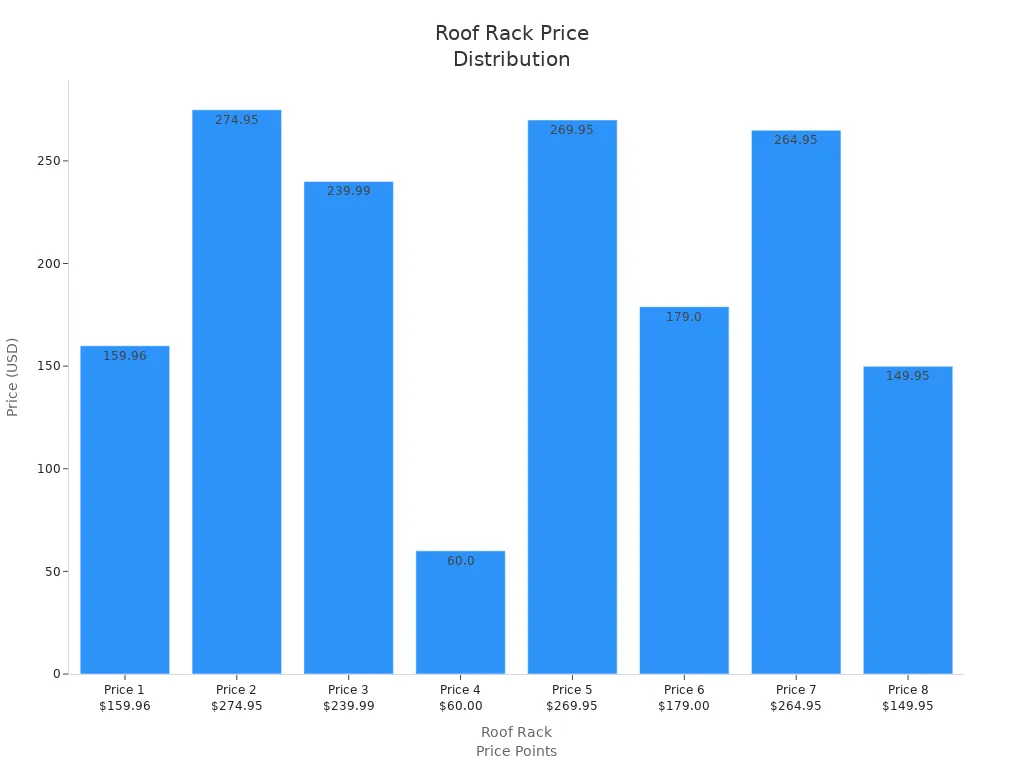
Tip: A higher price often means better materials and more features, but always check if those features match your needs.
Premium vs. Budget Options
You will find both premium and budget roof racks in stores. Premium racks use high-quality materials. They last longer and protect your gear better. Many premium racks have aerodynamic shapes. These shapes help reduce wind noise and save fuel. Premium brands often cost between $300 and $600. They also offer better security features.
Budget racks cost less, usually between $100 and $250. They work well for light or occasional use. If you only need a rack for a few trips each year, a budget option may be enough. However, budget racks may not last as long or keep your gear as safe.
Premium racks use strong materials for better durability.
Many premium models have designs that cut down on wind noise.
Budget racks are good for short trips or light loads.
Premium racks give you more security and last longer.
If you plan to use your roof rack often or carry heavy gear, a premium rack is a smart investment. For light use, a budget rack can save you money.
Installation & Maintenance
DIY vs. Professional Install
You face a choice when you start the installation of your roof pack. Many people try a DIY installation. You can save money and learn about your vehicle. Most roof packs come with clear instructions. You need basic tools for installation, such as a wrench and screwdriver. You should follow each step in the manual. If you skip steps, you risk damage or poor installation.
Professional installation gives you peace of mind. Experts know how to handle tricky mounting systems. You avoid mistakes that can lead to leaks or loose racks. Some shops offer a warranty on installation. You pay more, but you get a secure fit. If your roof pack needs special brackets, professional installation works best.
Here is a table to help you decide:
Installation Type | Pros | Cons |
|---|---|---|
DIY | Saves money, learn skills | Risk of errors, no warranty |
Professional | Expert fit, warranty | Higher cost |
Tip: If you feel unsure about installation, ask a professional for help. Safety matters most.
Roof Pack Care Tips
You keep your roof pack working well with regular care. After installation, check all bolts and clamps. Tighten them if you see movement. Wash your roof pack after each trip. Dirt and salt can damage the surface. Use mild soap and water for cleaning. Avoid harsh chemicals.
Inspect your roof pack before each installation. Look for cracks or rust. Replace damaged parts right away. Store your roof pack in a dry place when not in use. Cover it to protect from sun and rain. Lubricate locks and hinges every few months. This helps with smooth installation and removal.
Follow these steps for easy maintenance:
Check bolts and clamps after installation.
Clean with soap and water.
Inspect for damage before installation.
Store in a dry place.
Lubricate moving parts.
Note: Good care after installation helps your roof pack last longer and keeps your gear safe.
Buy or Rent Roof Pack
When to Buy
You should buy a roof pack if you use it a lot. Buying lets you pick the style and size you want. You can use your roof pack for many trips. You do not have to worry about rental times or extra costs. You can add accessories to make it fit your needs.
Buying a roof pack is good for long-term use. You get something you can use for years. Owning your gear gives you security and makes you feel proud. If you have steady money and travel often, buying is a smart idea.
Here is a table with things to think about:
Factor | Buying | Renting |
|---|---|---|
Financial Stability | Needs good credit for best deals | Predictable costs |
Market Trends | Timing affects value | Less impact from changes |
Tax Incentives | Possible deductions | No tax breaks |
Maintenance Responsibilities | You handle upkeep | Rental company handles repairs |
Lifestyle Flexibility | Less flexible, more commitment | Easy to relocate |
Long-term Financial Impact | Asset may appreciate | No asset accumulation |
Emotional Considerations | Sense of security and ownership | May feel less stable |
Tip: Buy a roof pack if you want to use it often and get good value.
When to Rent
Renting a roof pack is good for short trips or special events. You do not pay a big price at first. You only pay for the time you use it. The rental company fixes and cleans the roof pack for you. You can pick daily or weekly rates to save money.
Renting gives you freedom. You can try different styles and sizes. You do not have to keep the same roof pack. If you travel once or twice a year, renting saves money.
Think about these things when renting:
You do not pay a big price up front.
The rental company takes care of repairs.
Daily and weekly rates help you plan your budget.
Renting is good for short trips or rare use.
You can change roof pack types for each trip.
Note: Renting is best if you want to save money and have more choices for travel.
Quick Checklist & Common Mistakes
Roof Pack Selection Checklist
You want to make sure your roof pack fits your needs. Use this checklist before you buy or install a roof pack. This helps you avoid problems and keeps your gear safe.
Check if your roof pack matches your vehicle type.
Look for racks that fit your car’s roof style.
Make sure the weight capacity meets your cargo needs.
Choose a roof pack that works for utility and work equipment.
Pick racks that can hold ladders or toolboxes if needed.
Think about safety features for your gear.
Select versatile options for different trips.
Find racks that can carry canoes, kayaks, or bicycles.
Make sure you have space for camping equipment.
Review the installation instructions for your roof pack.
Inspect all straps and fasteners before each trip.
Tip: Always double-check your roof pack’s compatibility and load limits. This keeps your vehicle safe and your gear secure.
Mistakes to Avoid
You can make mistakes when you choose or use a roof pack. These mistakes can damage your car or put your gear at risk. Learn about the most common errors so you can avoid them.
Overlooking the importance of aerodynamics can waste fuel.
Using the wrong type of roof rack may cause poor fit or unsafe transport.
Ignoring maintenance of the roof rack can lead to rust or loose parts.
Misplacing items on the roof rack can make your load unstable.
Forgetting to check the straps may let gear fall off.
Using the wrong fasteners can weaken your setup.
Neglecting weather considerations can ruin your cargo.
Driving too fast with a loaded roof rack increases risk.
Not removing the roof rack when not in use can lower fuel efficiency.
Note: You protect your car and your gear when you avoid these mistakes. Take time to check your roof pack before every trip.
When you pick a roof pack, think about what is important for your car and trips. Some main things to look at are:
Cargo needs
Roof pack type and material
Security and locking mechanism
Ease of installation and maintenance
Aerodynamics, noise level, and style
Warranty and customer support
Choosing a roof pack that fits your car and cargo helps you stay safe. It also makes your trips better. Check the list and FAQ to help you decide with confidence.