

You count on hospital air conditioning to keep patients safe and comfortable. It also helps stop infections from spreading. Hospitals have special HVAC problems. They must control temperature, humidity, and air quality very carefully. If you do not use good hospital ventilation, people may get headaches or feel tired. They might have dry eyes, itchy skin, or breathing problems. Some may even get infections. The U.S. Environmental Protection Agency makes rules for hospitals to lower these risks. Using the right system rules helps your hospital stay safe and follow the law.
Why Hospital Air Conditioning Matters
Patient Safety and Comfort
Every patient should feel safe and comfortable in the hospital. Hospital air conditioning is very important for this. A good HVAC system helps patients heal faster and feel better. Recent studies show some key things:
HVAC systems help patients get better results, especially when it is hot outside.
Air conditioning helps people with chronic diseases by helping their blood pressure, breathing, and heart.
Patients in rooms with the right temperature and humidity can get up sooner and leave the hospital faster.
HVAC systems protect people from getting sick from heat and can lower the chance of dying.
Most patients say air conditioning helps them feel better, but a few may feel a little uncomfortable.
A good system keeps everyone safe and comfortable in the hospital.
Infection Control Role
Hospitals must stop infections from spreading. HVAC and ventilation systems help with this job. Studies show the air inside affects infection rates and how well patients do. Here are some important facts:
How you control air temperature and ventilation can change how often patients get infections.
Hospitals use special rules for HVAC systems in isolation rooms to keep germs from spreading.
You should keep airflow, air changes per hour, and humidity at safe levels to protect patients.
Experts say hospitals should keep checking and making these systems better to stop infections.
A strong system helps keep patients safe from germs.
Operational Efficiency
Hospitals need to work well and save money. Good hospital air conditioning helps with this in many ways:
Benefit | Contribution to Efficiency and Savings |
|---|---|
Energy Audits | You can find and fix problems in your HVAC system, which saves money. |
Improved Comfort | Patients heal better and staff work well when the climate is steady. |
Compliance with Regulations | You follow health rules and might get extra money, which helps the hospital’s budget. |
The right system helps you give better care, save money, and follow the rules.
Hospital HVAC Standards and Codes
Hospitals must follow strict rules for HVAC systems. These rules help keep patients, staff, and visitors safe. They also make sure hospitals follow the law. If you do not follow these rules, patients could be in danger. The hospital could lose its accreditation. You need to know the main rules for HVAC system compliance in hospitals.
AIA and ASHRAE Guidelines
Two main groups make hospital HVAC rules. They are the American Institute of Architects (AIA) and the American Society of Heating, Refrigerating and Air-Conditioning Engineers (ASHRAE). These groups set rules for things like air changes and temperature. Hospitals must follow these rules to stay safe and legal.
Tip: Always look for new updates from AIA and ASHRAE. These rules can change when new research comes out.
Here is a table with some important hospital HVAC system rules:
Requirement | Specification |
|---|---|
Air Changes per Hour (ACH) | Minimum of 12 ACH for new constructions; 6 ACH for existing facilities (AIA) |
Pressure Control | Minimum differential pressure of 2.5 Pa (0.01” water gauge) |
Temperature Control | Average temperature of 75°F |
HEPA Filtration | Required for isolation rooms to remove 99.97% of airborne particles ≥0.3 µm |
Emergency Power Supply | Necessary for air conditioning in isolation rooms to prevent depressurization |
Hospitals must meet all these rules to follow the law and keep everyone safe.
Air Pressure and Air Changes
Hospitals must control air pressure and air changes in every area. These rules help stop germs from spreading. Special care is needed in places like operating rooms and isolation rooms.
Isolation rooms should have lower pressure than the hallway.
About 15 air changes per hour (ACH) are recommended.
Negative-pressure isolation rooms need at least 12 air changes of exhaust per hour.
There must be at least a 0.01-inch water column (WC) negative-pressure difference to the hallway.
Positive-pressure isolation rooms need at least 12 air changes per hour of supply air.
There must be at least a 0.01-inch WC positive-pressure difference.
If you do not follow these rules, infection risk goes up. Studies show more air changes lower virus levels and risk. Fewer air changes let viruses build up and spread. Bad airflow can move viruses farther than six feet. This makes infection more likely. Hospitals must use proper HVAC system compliance to keep people safe.
Evidence Type | Findings |
|---|---|
Air Change Rate Impact | Higher ACH rates lower exposure risks and reduce virus concentrations. Lower ACH rates increase virus accumulation and infection rates. |
Virus Transport | Improper airflow can move viruses beyond six feet, raising infection risk. |
Air Purifiers | Air purifiers can reduce airborne virus levels. |
ACH and Viral Load | Higher ACH rates lower viral load and infection rates. |
Filtration and Air Quality
Hospitals need strong filters to keep indoor air clean. HEPA filters are the best for hospital HVAC system compliance. These filters remove 99.97% of airborne particles as small as 0.3 microns. They catch dust, pollen, bacteria, and some viruses. Without HEPA filtration, air quality can get bad and diseases can spread.
HEPA filters are tested with special aerosols to make sure they work.
These filters are made to catch almost all particles at 0.3 microns, which is important for hospital air.
HEPA filters work even better for particles bigger or smaller than 0.3 microns.
Hospitals face many air quality problems. Sick patients can put germs in the air. Old ducts may not filter air well, so pollution can move around. Outside air can bring in pollution too. Hospitals need good filters to remove these things and keep the air safe.
Note: Good air filtration is very important for patient health. Hospitals must use the right filters to meet all rules and keep air quality high.
Hospitals must follow all rules and standards for HVAC system compliance. This keeps patients safe, meets the law, and helps the hospital run well.
Hospital Ventilation for Infection Control
Airborne Pathogen Prevention
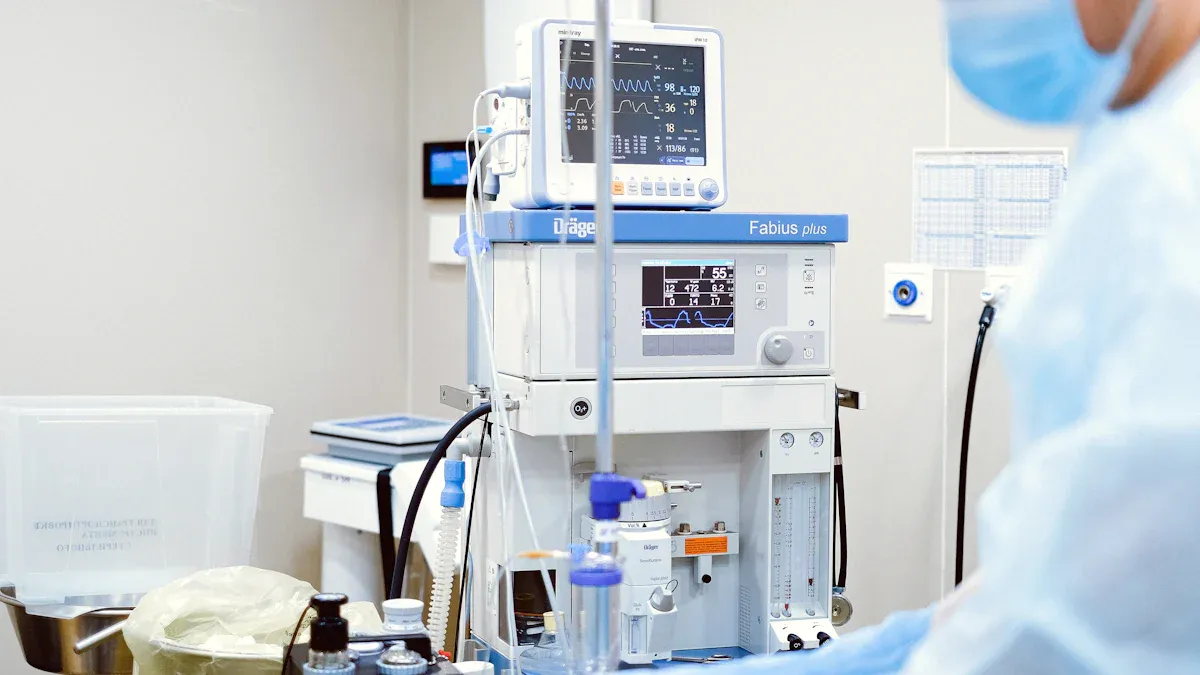
Strong ventilation is needed to stop germs in the air. Germs like tuberculosis and influenza can spread through the air. Good ventilation brings in fresh air and removes dirty air. This lowers the chance of people getting sick in the hospital. Ultraviolet light can also help clean the air. UV light kills viruses and bacteria as air moves through special units. This makes the air safer for everyone. Cleaning surfaces and putting sick patients in special rooms also helps stop germs from spreading.
Isolation Room Ventilation
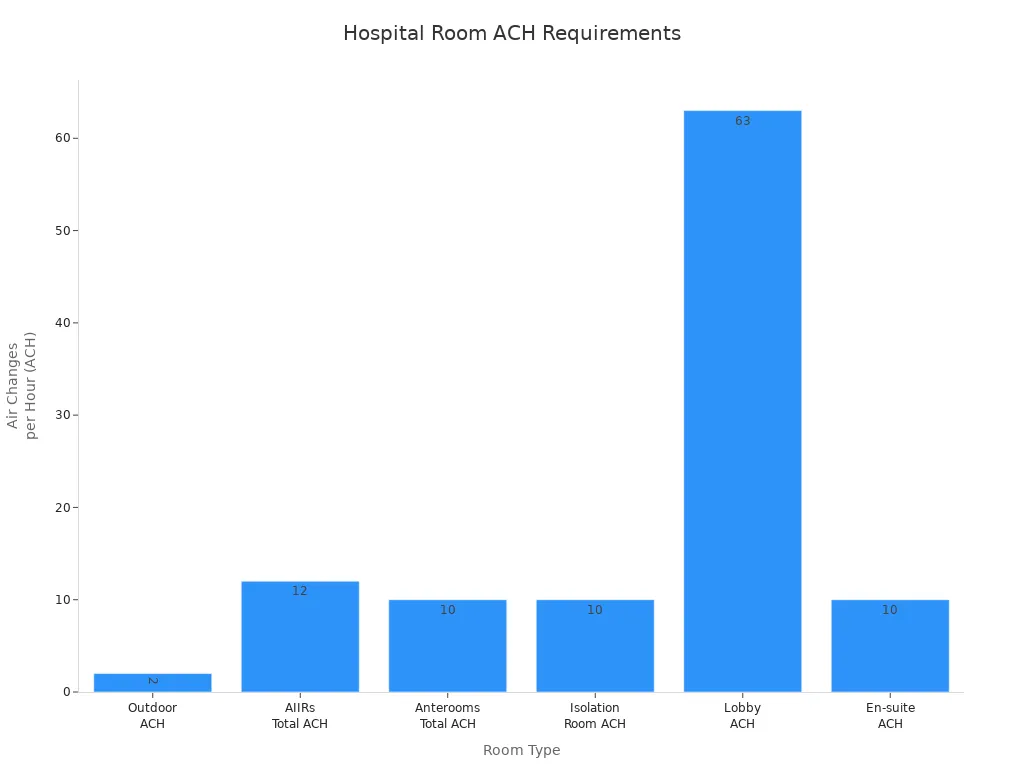
Isolation rooms are very important for stopping infections. You must follow strict rules for ventilation in these rooms. Negative pressure is used so air goes into the room but not out. This keeps germs from leaving the room. The table below shows the main rules for airflow and pressure in isolation rooms:
Requirement Type | Specification |
|---|---|
Pressure Relationship | Negative pressure to adjacent areas (-2.5 Pa) |
Minimum Outdoor ACH | 2 |
Minimum Total ACH for AIIRs | 12 |
Minimum Total ACH for Anterooms | 10 |
Pressure Differential for AIIRs | Minimum of 0.01-in water gauge (2.5 Pa) |
Airflow Direction for Anterooms | Clean-to-dirty airflow |
Anteroom Requirement | Required for immunosuppressed patients |
Isolation Room Pressure Differential | Nominally 0, ACH 10 |
Ventilated Lobby Pressure Differential | +10 Pa, ACH 63 (bed access) |
En-suite Pressure Differential | Negative, ACH 10 |
Zoning and Airflow
Zoning and good airflow help keep people safe in hospitals. Zoning means making different areas for clean and dirty work. For example, surgical rooms are kept clean and away from other places. Airflow systems move clean air to important spots and push dirty air away. Airlocks and special doors help control how air moves between zones. The Protected Occupied Zone Ventilation idea splits rooms into smaller parts. This keeps clean air near patients and lowers the risk of spreading germs. Good airflow and strong filters work together to keep hospitals safe.
Energy Efficiency in Hospital HVAC Systems
Efficient System Design
You can make hospital hvac systems use less energy with smart design. Picking the right system saves energy and keeps patients safe. Here are some good ideas to try:
Change old equipment to new hvac systems with sensors for people.
Use heat recovery systems to turn waste heat into useful energy.
Put in insulated windows with shades that move by themselves to stop energy loss.
Add building management systems to watch and control energy use.
Use LED lights and automatic controls to use less power.
Teach staff to follow steps that save energy every day.
Add solar panels or other renewable energy to help your hospital go green.
Doing these things can help you save a lot of energy. Some hospitals saved up to 14% on energy by upgrading systems. Others saved as much as 67% by making their systems the right size and updating them.
Maintenance and Monitoring
You need to keep hospital hvac systems working well to keep patients safe and save money. Doing regular checks and watching the system helps you find problems early. The table below shows why this is important:
Benefit | Description |
|---|---|
Equipment Longevity | Maintenance helps your system last longer and work better. |
Reduced Failures | You avoid breakdowns and keep your hospital running. |
Compliance with Regulations | You meet all safety and compliance rules for healthcare. |
You should change filters often and clean ducts to keep the air clean. Special cleaning during maintenance stops germs from spreading. Watching the system closely also helps you follow all the hospital hvac rules.
Flexibility and Redundancy
You must be ready for emergencies and changes in hospital hvac systems. Flexible design lets you change things when you need to. Redundancy means you have backup systems if something breaks. Here are some important steps:
Practice | Description |
|---|---|
Thorough Planning and Zoning | Make separate systems for important hospital areas. |
Regular Maintenance | Change filters and clean coils on time. |
Validation and Testing | Check airflow, pressure, and air changes often. |
Redundancy | Use backup units to keep things working if one fails. |
Staff Training | Teach your team about special hvac needs in hospitals. |
When you plan for flexibility and redundancy, you stop downtime and keep patients safe. Upgrading your system can also make it work better and cost less. For example, one hospital kept working even after losing a chiller because they planned and designed their system well.
Smart Technologies in Hospital HVAC
Automated Controls
Automated controls can help hospitals be safer and work better. These controls let you set air quality, temperature, and humidity very carefully. Many hospitals use smart systems that change settings when more or fewer people are in a room. For example, occupancy sensors save energy when rooms are empty. When people come back, the system makes the room comfortable again. Mercy’s facilities department uses these systems to control the climate and save a lot of money every year.
Smart systems use artificial intelligence and machine learning. These tools look at old and new data to make good choices for comfort and saving energy. AI can guess when you will need more cooling or heating. It changes the system before you even notice. Hospitals also use IoT-enabled HVAC systems to control temperature and humidity. This keeps patients safe and comfortable.
Here is a table that shows how automated controls help hospitals:
Feature | Benefit |
|---|---|
Precise Monitoring | You get the right air flow and meet air quality rules. |
Real-time Adjustments | The system changes settings fast when rooms are used or empty. |
Compliance with Standards | You follow rules like ASHRAE 62.1 and save energy. |
Data and Remote Monitoring
Data and remote monitoring help hospitals run well. These tools let you check your HVAC system from anywhere. Real-time monitoring helps you find problems early and fix them fast. One hospital in Texas saved over $300,000 each year by using remote monitoring. Another hospital used these tools and cut cooling energy use in half.
With remote monitoring, you can:
Watch temperature and humidity all the time.
Control your system from far away.
Find and fix problems before they get worse.
Save money by using less energy.
Hospitals now use IoT and digital tools for central monitoring. This helps you act quickly and keep your system working right. You can also use data to plan repairs and stop big problems. Smart technologies make hospitals safer, more comfortable, and more efficient.
Collaborative Design for Hospital Air Conditioning
Multidisciplinary Teams
You need a team with many skills to make a good air conditioning system for your hospital. Each person has their own ideas. When engineers, doctors, nurses, and facility managers work together, they solve hard problems. Here is how a team like this helps:
The team uses many skills to fix tough air conditioning problems.
You can make better plans and follow safety rules.
Teamwork brings new ideas that help air quality and save money.
Working together lets you upgrade systems quickly, so patients stay safe.
Tip: Start working with your team early to get the best results.
Stakeholder Engagement
You should talk to everyone who uses or runs the building when you plan a new HVAC system. This means speaking with doctors, nurses, patients, and leaders. Listening to their ideas helps you learn what each group needs. This helps you make smart choices about saving energy and making spaces work well. You get better results when you include people who care about the hospital’s future. Their advice helps you reach your goals for a safe and green building.
Ongoing Training
You must keep learning to manage hospital HVAC systems well. Training helps your staff know the newest rules and best ways to work. Here are two helpful courses:
Course Title | Length | Focus Areas |
|---|---|---|
Healthcare Facilities: Best Practices Applications of HVAC Systems | 3 hours | Room pressurization, design practices, energy conservation, commissioning, patient outcomes |
Healthcare Facilities: Best Practices for HVAC Design and Operation | 6 hours | Infection control, energy conservation, operational issues, design of air handlers, and more |
When your team learns new skills, you keep your hospital safe and working well.
You help patients stay healthy when you follow hospital air conditioning rules. These rules keep everyone safe and help the hospital work well. The table below shows how these rules help you and your patients:
Benefit | How It Helps You and Patients |
|---|---|
Infection Control | Stops germs from spreading and keeps patients healthy |
Airflow Management | Keeps air clean in operating rooms and isolation spaces |
Compliance | Meets inspection needs and helps the hospital keep its approval |
You can be a leader by making hospital air conditioning very important.
Always follow the rules and update your systems before problems happen.
Check how things are going and help your team do their best.
Spend money on systems that protect patients and use less energy.