

If you want the best cooling for your home, both mini split ac only and heat pump systems work well. Your choice depends on where you live, your budget, and if you need heating too. Mini split ac only units make sense if you just want cooling. A heat pump gives you both heating and cooling, so you get a flexible heating and cooling solution. Think about your home’s size and layout, how many rooms you want to cool, and your local weather.
Mini split ac only units are easy to install and perfect for single rooms or smaller homes.
Heat pumps suit larger homes and provide comfort all year.
Mini Split AC Only
How It Works
A mini split ac only system does not use ducts. It cools your home with an outdoor condenser and indoor air handlers. These connect by a small tube in your wall. The system takes heat from your room and sends it outside. This keeps your room cool and comfy.
Here’s a quick comparison between mini split ac only and traditional central air conditioning:
Feature | Mini-Split AC System | Traditional Central Air Conditioning System |
|---|---|---|
System Type | Ductless system with outdoor condenser and one or more indoor air handlers | Ducted system with centralized outdoor condenser and indoor air handler connected to duct network |
Cooling Mechanism | Transfers heat from indoor air to refrigerant; refrigerant releases heat outside | Draws warm air through air handler, cools it via refrigerant cycle, then distributes cooled air through ducts |
Compressor Operation | Uses inverter technology to vary compressor speed based on cooling demand, enabling energy efficiency and precise temperature control | Compressor runs at fixed speeds, cycling on/off to meet thermostat settings |
Air Distribution | Direct cooling in individual rooms with zoning capability | Even cooling throughout the entire home via ductwork |
Energy Efficiency | Higher efficiency due to no duct losses and variable compressor speed | Lower efficiency due to energy losses from duct leaks and fixed compressor operation |
Installation & Maintenance | Easier installation, less invasive, and lower maintenance due to absence of ducts | More complex installation with ductwork; requires regular duct maintenance |
Temperature Control | Room-by-room temperature customization | Single thermostat controls whole house temperature |
Mini-split systems let you control each room’s temperature. You do not lose energy because there are no ducts. The compressor can slow down or speed up. This saves energy and keeps your room just right.
Cooling Features
Mini split ac only units have many features that help you stay cool. Here are some things you get with these systems:
You can set each room to a different temperature.
They run quietly, so you hardly hear them.
They are easy to put in, with only a small hole needed.
You can use smart apps or speakers to control them.
They use new refrigerants that are better for the planet.
No ducts means no energy loss from leaks.
They filter the air to help keep it clean.
Inverter technology keeps the temperature steady.
The controls are simple and easy to use.
Ductless mini-split systems give you comfort without needing ducts. These cooling only units work great in bedrooms, offices, or new rooms. Ductless air conditioners last a long time. With good care, they can work for 15 to 20 years or more. Clean the filter often and get a yearly checkup to keep your mini-split working well.
If you want something easy to install, quiet, and able to cool each room, a mini split ac only is a good pick. Ductless mini-split cooling only systems are a smart way to keep your home cool if you do not need heat.
Heat Pump
Cooling Function
When you choose a mini split heat pump, you get a system that cools your home just like a mini split AC only unit. Both systems move heat from inside your house to the outside air. This process uses refrigerant cycles that absorb heat indoors and release it outdoors. You get cool air in your rooms, even on the hottest days.
The main difference is that a heat pump gives you both heating and cooling. You can switch between modes with a simple button. During summer, the heat pump works as an air conditioner. It pulls heat out of your living space and keeps you comfortable. In winter, it reverses the process and brings warmth inside. This flexibility means you stay comfortable all year.
Mini split heat pumps use indoor air handlers for each room. You can set different temperatures in each space. This zone control helps you save energy and keeps everyone happy. If you want to keep your bedroom cooler than your living room, you can do that easily.
Tip: Regular maintenance, like cleaning filters and checking refrigerant, helps your heat pump deliver strong cooling during peak summer months.
Efficiency
You might wonder how efficient a mini split heat pump is. Most models have a high Seasonal Energy Efficiency Ratio (SEER). Many units reach around 20 SEER, and some go above 30. Brands like Carrier and GREE offer systems with SEER ratings from 16 up to 38. This means you get great cooling without wasting energy.
Heat pump efficiency comes from inverter technology and variable-speed compressors. These features let your system adjust its cooling output to match your needs. When it gets really hot, the compressor speeds up. When you need less cooling, it slows down. This smart adjustment saves energy and keeps your home at the perfect temperature.
You also get better energy efficiency because you avoid duct losses. Ductless heat pumps deliver cool air right where you need it. If you want a system that gives you both heating and cooling with top efficiency, a mini split heat pump is a smart choice.
Heat Pump vs Mini Split

Cooling Performance
When you look at heat pump vs mini split AC only systems, you might wonder if one cools better than the other. The truth is, both systems offer strong cooling for your home. They use the same technology to move heat out of your rooms and keep you comfortable. You can find both types with similar cooling capacities, so you do not have to worry about one being weaker.
Here’s a table to help you see the typical cooling capabilities for different room sizes:
Room Size (sq ft) | Typical Cooling Capacity (BTUs) |
|---|---|
150 to 250 | 6,000 |
250 to 300 | 7,000 |
300 to 350 | 8,000 |
350 to 400 | 9,000 |
400 to 450 | 10,000 |
450 to 550 | 12,000 |
550 to 700 | 14,000 |
700 to 1,000 | 18,000 |
1,000 to 1,200 | 21,000 |
1,200 to 1,400 | 23,000 |
Up to 1,500 | 24,000 |
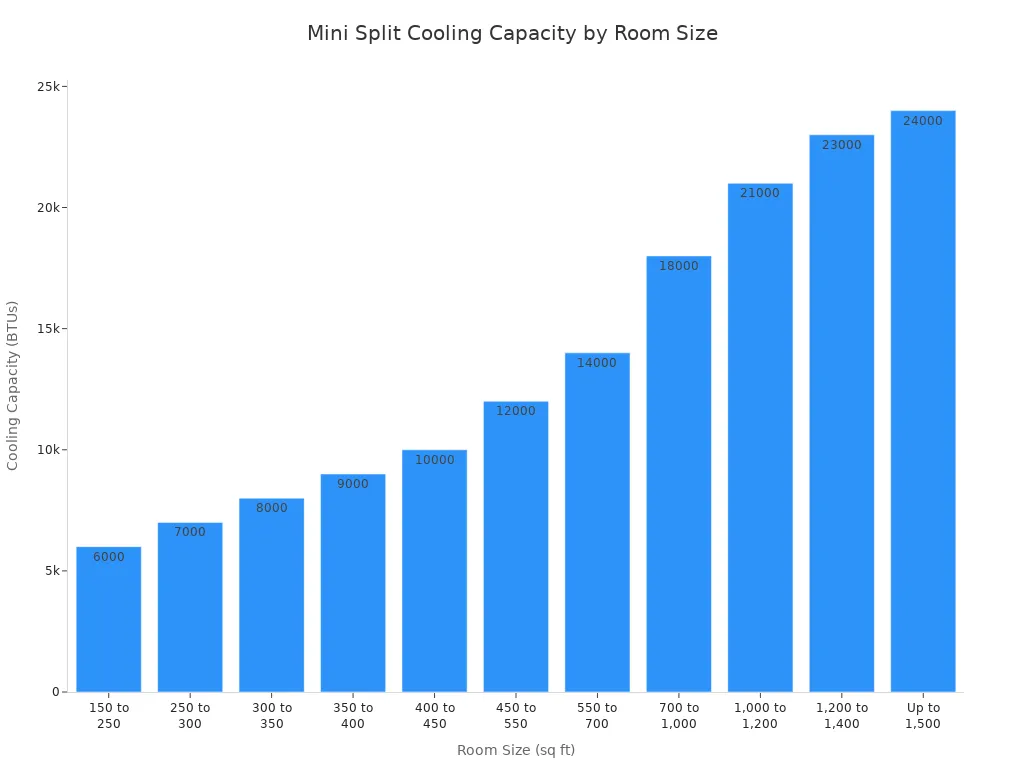
Both heat pump and mini split AC only systems cover the same BTU range. This means you can cool a small bedroom or a large living room with either option. If you want cooling only, a mini split AC works great. If you want both heating and cooling, a heat pump gives you that flexibility without losing any cooling power.
Note: You get the same cooling performance from both systems, so your choice depends more on whether you need heating too.
Energy Use
You probably care about how much energy your system uses. When you compare heat pump vs mini split AC only, you will find that both are very efficient. They use inverter technology and do not lose energy through ducts. This helps you save money on your electric bill.
Mini split systems, including heat pumps, usually have higher SEER ratings than old central air systems.
Zoning lets you cool only the rooms you use, which saves even more energy.
SEER measures how well your system cools over a season. EER measures it at one temperature.
Heat pumps with high SEER ratings also heat well, thanks to their HSPF rating.
You will see that both systems give you top efficiency for cooling. If you want to lower your energy use, either choice works. Heat pumps add the bonus of heating, but they do not use more energy for cooling than a mini split AC only.
Cost
Cost is a big part of the heat pump vs mini split decision. You want to know what you will pay up front and over time. Let’s break it down:
System Type / Zones | Typical BTU Range | |
|---|---|---|
Single-Zone Mini Split AC | 6,000 – 18,000 | $2,500 – $4,500 |
Dual-Zone Mini Split AC | 12,000 – 24,000 | $4,500 – $7,500 |
Three-Zone Mini Split AC | 18,000 – 36,000 | $6,500 – $9,500 |
Four-Zone Mini Split AC | 24,000 – 42,000 | $8,000 – $12,000 |
Five-Zone Mini Split AC | 30,000 – 60,000 | $10,000 – $15,000 |
The price for a heat pump system is usually a bit higher than for a mini split AC only. This is because heat pumps can both heat and cool your home. You might pay more at first, but you get year-round comfort. Both systems need professional installation, and the cost goes up if you add more zones or need a complex setup.
When you look at long-term costs, heat pumps often give you more savings. They last a long time and have lower yearly maintenance costs, usually between $100 and $300. Mini split systems also need regular cleaning and checkups, which adds to your yearly expenses. If you live in a place with high electricity rates, heat pumps may cost more to run in winter, but for cooling, both systems are similar.
Tip: You can get cost savings by checking for rebates or tax credits when you install a new system.
In the end, the heat pump vs mini split choice comes down to your needs. If you want cooling only, a mini split AC is simple and effective. If you want both heating and cooling, a heat pump gives you more flexibility and long-term savings.
Mini-Split Heat Pumps
Ductless Benefits
When you choose mini-split heat pumps, you get a ductless system that makes life easier. You do not need to worry about big, messy ductwork. Most mini-split systems only need a small hole in your wall for the conduit. This means less hassle and less mess in your home. You save time and money on installation.
Here are some big benefits of ductless mini-split heat pumps:
You avoid the cost and trouble of adding ducts. This is perfect if your home does not have any ductwork.
Mini-split heat pumps work great for new rooms or additions where you cannot run ducts.
You get to control the temperature in each room. This makes your home more comfortable and saves energy.
Ductless mini-split systems heat or cool only the rooms you use. This means faster temperature changes and lower energy bills.
Did you know? Ducted systems can lose 20-30% of energy through leaky ducts. With ductless mini-split heat pumps, you keep that energy in your home.
Mini-split heat pumps also last a long time. With good care, your ductless mini-split can work for up to 20 years. You get a reliable heating and cooling solution that fits almost any home.
Zone Control
Mini-split heat pumps give you zone control. This means you can set different temperatures in different rooms. You do not have to cool or heat the whole house if you only use one room. Each indoor unit has its own remote or app control. You can make your bedroom cool and your living room warm at the same time.
Zone control in ductless mini-split heat pumps helps you save energy. You only use power for the rooms you need. This can cut your energy costs by 30-40% compared to old forced air systems. You also avoid hot or cold spots because you control each zone. Mini-splits use smart inverter compressors that adjust to your needs, making your home even more comfortable.
Here’s a quick look at how mini-split heat pumps compare for home value and comfort:
Feature/Aspect | Heat Pump (Ducted & Ductless) | Mini Split AC System (Ductless Heat Pump) |
|---|---|---|
Increase in Home Resale Value | $10,000 to $17,000 depending on system and efficiency | Up to around $17,000 due to energy efficiency and customization |
Energy Efficiency | High, reduces energy bills significantly | Very high, offers more customization and zone control |
Comfort | Zone control available, long lifespan | Individual room temperature control, ideal for split-level or multi-story homes |
If you want a flexible, energy-saving, and easy-to-use heating and cooling solution, heat pump mini splits are a smart choice. Ductless heating and cooling gives you comfort, savings, and control.
Cooling and Climate
Hot Climates
If you live in a place where summer feels endless, you want a system that keeps you cool all day. Mini split AC only units work great in hot climates. They focus on cooling and do not have extra parts for heating. This makes them simple and reliable. You get strong cooling power, even when the temperature outside soars.
Heat pumps also cool well in hot weather. They use the same technology as mini split AC units. You will not notice a difference in cooling performance. The main thing to think about is if you need heat in the winter. In places where it rarely gets cold, you might not need the heating feature. You can save money by choosing a mini split AC only system.
Tip: If you only care about cooling and want to keep costs down, a mini split AC only unit is a smart choice for hot climates.
Moderate Climates
In areas with mild summers and winters, you have more options. You might want a system that does both heating and cooling. Mini split heat pumps give you this flexibility. You can cool your home in summer and warm it up in winter, all with one system.
Here are some energy-efficient cooling solutions for moderate climates:
Ductless mini-split air conditioners offer zoned cooling and work well in homes without ducts.
Evaporative coolers use less energy and are great for dry areas.
Ceiling fans help move air and lower your cooling costs.
Programmable thermostats let you control your cooling schedule and save energy.
Central air systems with high SEER ratings give steady comfort and save money if you keep them maintained.
Zoning systems, like wall-mounted mini splits, let you cool only the rooms you use. This saves energy and keeps your bills low. You can set each room to the temperature you like. If you want both heating and cooling capabilities, a mini split heat pump is a great fit for moderate climates.
Note: If your winters are mild, you may not need much heating. In that case, a mini split AC only unit could still work for you. But if you want year-round comfort, a heat pump gives you both options.
Installation
Process
You might wonder what happens when you install a mini split AC or heat pump. The process is pretty straightforward, but it does need a professional touch. Here’s what you can expect during installation:
Unpack and check all the indoor and outdoor units for any damage.
Pick the best spots for both units. You want good airflow and strong support.
Attach the wall bracket for the indoor unit. Make sure it’s level and secure.
Drill a hole through your wall. This hole lets the refrigerant lines, drain hose, and cables pass through. The hole should angle downward for proper drainage.
Mount the indoor unit on the bracket and feed the lines through the hole.
Place the outdoor condenser on a flat, stable surface with enough space around it.
Connect the refrigerant lines and electrical wiring between the indoor and outdoor units. Always follow safety codes and wiring diagrams.
Use a vacuum to remove air and moisture from the system. Test for leaks to make sure everything is sealed tight.
Seal up the hole in your wall and add protective covers. The installer will also show you how to use your new system.
Tip: A professional installer will also check your home’s electrical system to make sure it can handle the new unit. You’ll get a quick lesson on how to use your remote or app, too!
Cost Factors
The price for installing a mini split AC or heat pump can change a lot. Here are some things that can make the cost go up or down:
The type of unit you pick—mini split, packaged, or geothermal—changes the price.
Brand matters. Some brands cost more because they offer better quality or extra features.
Bigger units with higher BTU ratings cost more.
High-efficiency models with better SEER or HSPF ratings usually have a higher price tag.
Extra features like staged heating or cooling add to the cost.
If your home needs new wiring or you want a ceiling mount, expect to pay more.
The number of zones and how far apart the units are will affect labor and material costs.
Where you live can change labor costs, especially if installers have to travel far.
Supply chain issues or buying from a professional dealer can also impact the final price.
Note: Professional installations often cost more, but you get better warranties and support. Always ask about financing options and rebates to help with the cost!
Choosing the Right System
Key Questions
Picking between a mini split AC only system and a heat pump can feel tricky. You want to make sure you get the right fit for your home and your needs. Here are some questions to help you decide:
What is the climate like where you live? If you have hot summers and mild winters, a mini split AC only system might be all you need. If you get cold winters, a heat pump gives you both heating and cooling.
Do you need heating as well as cooling? If you already have a good heating system, you might not need a heat pump.
What is your budget? Mini-splits with just cooling usually cost less up front. Heat pumps cost more at first but can save you money over time.
How many rooms do you want to control? Mini-splits work great for single rooms or zones. Ductless heat pumps can handle multiple zones and give you more control.
Are you interested in energy savings or rebates? Heat pumps often qualify for bigger rebates and tax credits, especially if they are ENERGY STAR certified.
Do you care about noise? Ductless mini-splits run quietly, which is great for bedrooms or offices.
Tip: Think about your future needs. If you might want heating later, a heat pump could be a smart investment.
Summary Table
Here’s a quick look at how mini split AC only systems and ductless heat pumps compare:
Aspect | Mini Split AC Only | Ductless Heat Pump |
|---|---|---|
Functionality | Cooling only | Heating and cooling (year-round comfort) |
Ideal Climate | Warm climates, little heating needed | Seasonal temperature changes |
Upfront Cost | Lower | Higher, but more long-term savings |
Energy Efficiency | High for cooling | High for both heating and cooling |
Heating Capability | None | Yes, may need backup in extreme cold |
Zoning | Yes, great for single/multi rooms | Yes, excellent for whole-home control |
Installation | Ductless, easy for cooling zones | Ductless, supports zoned climate control |
Rebates/Incentives | Up to $600 tax credit if ENERGY STAR | Up to $2,000 tax credit, $8,000 rebate |
Pros | Lower cost, simple, quiet | Year-round comfort, energy savings |
Cons | No heating, not for cold winters | Higher cost, may need backup heat |
You can see that both mini-split and ductless heat pump systems offer strong cooling and easy installation. Mini-splits shine in warm climates and for single rooms. Ductless heat pumps give you more flexibility and bigger savings if you want both heating and cooling.
Choosing between a mini split AC only and a heat pump depends on your climate, budget, and future plans. Here’s what you should think about:
Climate: Mini splits work well in mild areas. Heat pumps handle cold winters, even down to -22°F.
Budget: Mini splits cost less to install. Heat pumps cost more upfront but offer year-round comfort.
Future Needs: Heat pumps give you both heating and cooling. Mini splits are great if you only want cooling.
For the best results, talk to a professional. They can help you pick the right size and system for your home’s layout and climate. You’ll get comfort, savings, and peace of mind.
System Type | Best For | Key Benefit |
|---|---|---|
Mini Split AC | Warm, mild climates | Lower cost, easy install |
Heat Pump | All climates, cold too | Heating + cooling in one |
FAQ
How long does a mini split system last?
Most mini split systems last 15 to 20 years. If you clean the filters and get yearly checkups, your system can keep running smoothly for a long time.
Can I install a mini split myself?
It’s best to let a professional handle the installation. You need special tools and skills to connect the refrigerant lines and wiring safely.
Do mini split heat pumps work in cold weather?
Yes! Many modern heat pumps work well even when it’s below freezing outside. Some models keep heating down to -22°F, so you stay warm all winter.
How often should I clean the filters?
You should check and clean the filters every month. Dirty filters make your system work harder and use more energy. Clean filters help you get the best cooling and heating.