

You want to choose the right water chiller. You may not know how to begin. Picking a chiller that fits your needs saves money. It also helps you use less energy. When you match the cooling system to your use, you pay less for electricity. Your setup will work better and be more reliable. Many industries like chillers with new technology. These chillers work well and cost less. This guide helps you feel sure about your choice.
What Is a Water Chiller
Water Chiller Basics
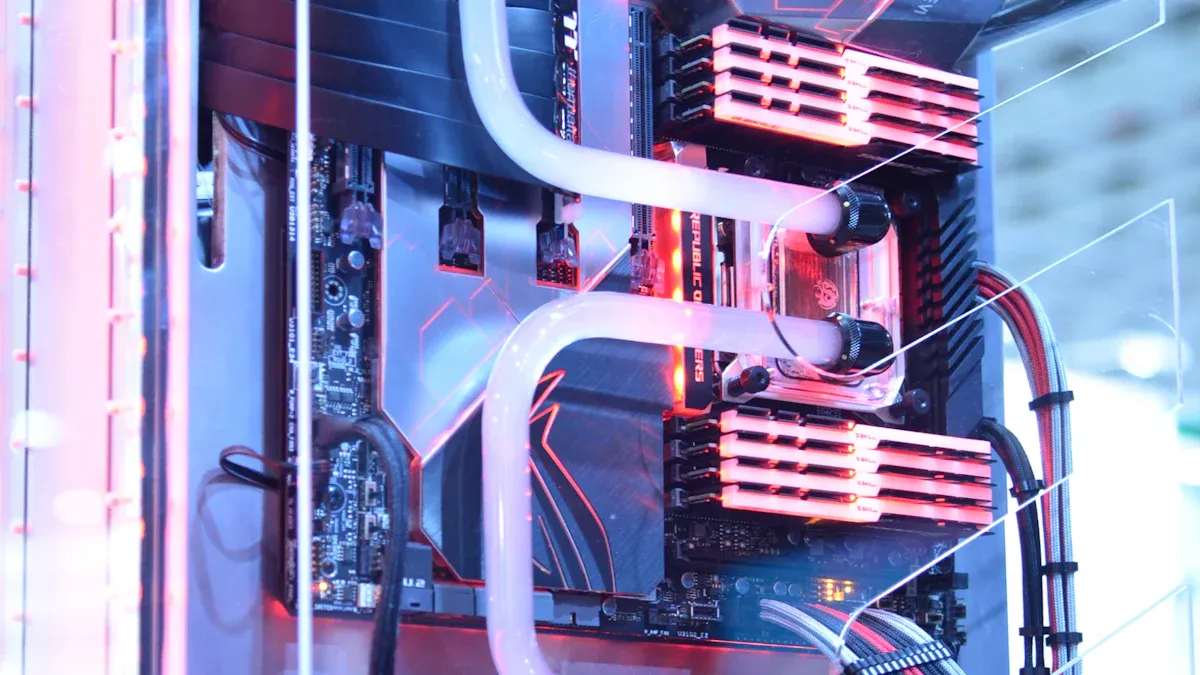
You may ask what a water chiller does. A water chiller is a machine that cools water or water-glycol mix. You use it to keep things at the same temperature. The water chiller takes heat out of the water. It sends cold water to your equipment or space. You can find water chillers in big buildings, factories, and farms.
Here’s a quick look at what a water chiller does:
Takes heat away from water or water-glycol mixes.
Sends cold water to machines or rooms that need cooling.
Helps things work well and stay safe.
A water tank chiller works with a water tank. It stores and cools water. You use a water tank chiller when you need lots of cold water ready. This setup is common in places that need cooling all day, like food factories or hospitals.
Let’s look at a table that shows what it means and how it is used:
Definition | Applications |
|---|---|
A water chiller is a refrigeration system where water acts as a secondary refrigerant, commonly used in HVACR setups. | District cooling, Centralized air conditioning, Hydroponics, Food and beverage processing, Pharmaceuticals, Cold storage, Thermal Energy Storage, Machining processes, Plastic processing. |
You often see an industrial chiller in big factories. An industrial chiller helps with metal work and plastic making. It keeps machines cool. You need an industrial chiller for strong cooling in big jobs.
Common Applications
You find water tank chillers in many industries. Here are some places where you use a water tank chiller:
Food and drink factories use water tank chillers for safe food storage.
Hospitals use water tank chillers to keep medicine and machines cool.
Plastic and rubber factories use water tank chillers to set molds and keep products strong.
Chemical plants use water tank chillers for safe mixing and cooling.
Data centers use water tank chillers to stop computers from getting too hot.
Industrial chiller systems are important in these places. You see industrial chillers in chemical plants, food factories, and hospitals. Industrial chillers help with cooling, safety, and saving energy. You also find industrial chillers in electronics, car factories, and places that need special cooling.
A water tank chiller is important for industrial cooling systems. You use a water tank chiller to keep things cool, safe, and working well. If you need steady cooling, a water tank chiller is a good choice.
Tip: If you want to save energy and keep your machines safe, pick the right water tank chiller for your needs.
Assess Cooling Needs
Identify Application Requirements
You want your cooling system to work well. First, you need to figure out what you need to cool. Are you setting up a water tank chiller for a small greenhouse, or do you need an industrial chiller for a busy factory? Your answer changes everything.
Let’s break down what you should look at:
Cooling capacity – You need to know how much heat your cooling system must remove. This helps you pick the right water tank chiller or industrial chiller.
Controls – Some chillers have smart controls. These help you keep the temperature steady and make your cooling system easier to manage.
Energy efficiency – You want a water tank chiller or industrial chiller that uses less power. This saves you money and helps the planet.
Cost – You need to think about your budget. Some chillers cost more upfront but save money over time.
You also need to check a few other things:
Cooling fluid – The type of fluid matters. Some water tank chillers use a water-glycol mix. This can help your cooling system last longer and work better.
Voltage – Make sure your water tank chiller matches your building’s power supply.
Environmental conditions – If your industrial chiller sits in a hot room, it may need extra power to keep things cool.
Determining the cooling capacity needed is vital; an undersized chiller can lead to performance issues and potential system failures. Additionally, the ambient temperature where the chiller operates can significantly influence its efficiency.
The choice of cooling fluid is important. Many people use a glycol-water mix in their water tank chiller. This helps prevent rust and keeps your cooling system running smoothly. If you use city water, check the quality. Bad water can damage your water tank chiller over time.
Calculate Heat Load
Now, you need to figure out how much heat your cooling system must handle. This step helps you pick the right size for your water tank chiller or industrial chiller.
Here’s how you can do it:
Heat Load Calculation Formula:
Q = Area (sq ft) × Heat Load Factor (BTU/hr per sq ft)
Example: If your area is 50,000 sq ft and the heat load factor is 30, then Q = 50,000 × 30 = 1,500,000 BTU/hr.Chiller Sizing Formula:
TR (Tons of Refrigeration) = Total Heat Load (BTU/hr) ÷ 12,000
Example: If your total heat load is 60,000 BTU/hr, then TR = 60,000 ÷ 12,000 = 5 TR.BTU/hr Calculation:
BTU/hr = Gallons per hr x 8.33 x ΔT°F
Example: For 4 gpm and a temperature difference of 10°F, BTU/hr = (4 gpm x 60) x 8.33 x 10°F = 19,992 BTU/hr.Cooling Capacity Calculation:
Tons = BTU/hr ÷ 12,000
Example: For 19,992 BTU/hr, Tons = 19,992 ÷ 12,000 = 1.666 tons.
A water-chiller refrigeration ton is 12,000 Btu/h. This number helps you size your water tank chiller or industrial chiller correctly.
If you pick a water tank chiller that is too small, it will run all the time and may break down. If you choose one that is too big, it will waste energy and wear out faster. Here’s a quick look at what happens if you get the size wrong:
Impact on Performance | Operational Costs | |
|---|---|---|
Undersized | Struggles to maintain temperature, leading to continuous operation | Increased energy consumption, potential breakdowns |
Oversized | Operates inefficiently, cycles too frequently | Higher operational costs, increased wear on equipment |
You want your cooling system to work just right. Take your time with these calculations. If you feel unsure, ask an expert for help.
Here are some common mistakes people make when choosing a water tank chiller or industrial chiller:
Failing to define cooling needs: Always check what you need before you buy or rent a water tank chiller.
Neglecting maintenance: Keep your cooling system in good shape with regular checkups.
Overlooking energy efficiency: Pick a water tank chiller that saves power.
Choosing the wrong type of chiller: Match your water tank chiller or industrial chiller to your job.
Ignoring local regulations: Make sure your cooling system follows the rules in your area.
Tip: Write down your cooling needs and heat load numbers. This helps you talk to suppliers and makes sure you get the right water tank chiller or industrial chiller for your cooling system.
Choose Water Chiller Type
Air-Cooled vs Water-Cooled
You can pick between two main types of water chiller. One is air-cooled and the other is water-cooled. Each type works best in different places. Let’s look at how they are different so you can choose the right one.
Cooling Method: Air-cooled chillers use air to cool things down. Water-cooled chillers use water to do the cooling.
Space Needs: Air-cooled chillers need less room. Water-cooled chillers need more space and extra parts like a cooling tower.
Installation and Cost: Air-cooled chillers are simple to put in and cost less at first. Water-cooled chillers need more work to set up and cost more when you buy them.
Efficiency: Water-cooled chillers are better at saving energy, especially for big jobs.
Climate Impact: Air-cooled chillers do not work as well when it is hot outside. Water-cooled chillers still work well even in hot weather.
Maintenance: Air-cooled chillers are easier to take care of. Water-cooled chillers need more checkups and care.
Here is a table that shows how where you live can change your choice:
Region Type | Reason for Preference | |
|---|---|---|
Water-abundant | Water-cooled chillers | Higher efficiency and lower energy use |
Water-scarce | Air-cooled chillers | No need for extra water, avoids water use problems |
Strict water rules | Air-cooled chillers | Meets regulations, uses less water |
Heavy water limits | Water-cooled chillers | May not work due to local restrictions |
Tip: If you live in a dry place or have little water, pick an air-cooled chiller. If you have lots of water and want to save energy, pick a water-cooled chiller.
Industrial Chiller vs Other Types
You may wonder when you need an industrial chiller instead of a regular water tank chiller. Industrial chillers are made for bigger and harder jobs. They are best for places that need strong and steady cooling.
Here are some times when you should use an industrial chiller:
Scenario | |
|---|---|
Rubber Manufacturing | Removes lots of heat fast, keeps machines running smoothly |
Injection Molding | Cools things quickly, helps make more products in less time |
Fermentation Tanks | Gives steady cooling when you can’t use waste heat |
If you run a big factory or need to cool large machines, an industrial chiller is the best choice. For smaller jobs, like a small greenhouse or just one water tank chiller, you do not need as much power. A water tank chiller is good for smaller, steady cooling needs.
You should always pick the right cooling system for your job. If you use a water tank chiller for a big factory, it may not be enough. If you use an industrial chiller for a small job, you might waste money and energy.
Note: Think about your space, how much water you have, and how much cooling you need before you choose. The right water tank chiller or industrial chiller will help your cooling system work well.
Determine Cooling Capacity
Sizing the Chiller
You want your water tank chiller to keep things cool and steady. To do this, you need to figure out the right cooling capacity for your setup. If you get this step right, your cooling system will work well and save you money.
Let’s walk through the steps you need to follow:
Find the Flow Rate and Temperatures
Start by measuring how much coolant moves through your system each hour. Write down the temperature when the coolant enters and leaves the chiller. This helps you see how much heat you need to remove.Calculate the Average Temperature
Take the inlet and outlet temperatures and find the average. This number helps you look up water properties like density and specific heat.Use the Energy Equation
You can use a simple formula to find the cooling capacity you need:Q = ṁ × Cp × ΔTQ is the cooling capacity (in BTU/hr or kW)
ṁ is the flow rate (in pounds per hour or kilograms per second)
Cp is the specific heat of the coolant (water or water-glycol mix)
ΔT is the temperature difference between inlet and outlet
Convert to Tons of Cooling
Once you have Q, you can convert it to tons of cooling. One ton equals 12,000 BTU/hr. Divide your Q by 12,000 to get the size you need.Adjust for Temperature Control
If you need tight temperature control, make sure your chiller can handle changes in temperature. Sometimes, you need to adjust your numbers if you want the water to leave the chiller at a lower temperature.
Here’s a table to help you see the steps:
Step | What You Do |
|---|---|
Measure flow rate | Find out how much coolant moves per hour |
Record inlet/outlet temps | Write down entry and exit temperatures |
Calculate average temp | Find the average for water properties |
Use energy equation | Q = ṁ × Cp × ΔT |
Convert to tons | Divide Q by 12,000 |
Adjust for control needs | Change numbers for tighter temperature control |
Tip: Always check the type of coolant you use. Water and water-glycol mixes have different properties. This can change your cooling capacity numbers.
When you size your water tank chiller, think about the flow rate and pressure. If the flow is too low, your cooling system may not remove enough heat. If the pressure is too high, you could damage your equipment. You want the right balance for safe and steady temperature control.
Using Performance Curves
After you figure out the cooling capacity, you need to match your chiller to your job. This is where performance curves help you. These curves show how a chiller works under different conditions.
Performance curves give you important data:
You see how much cooling capacity your chiller has at different temperatures.
You learn how the chiller performs when the flow rate changes.
You find out how efficient the chiller is at different points.
If you look at a performance curve, you can see if your water tank chiller will meet your needs. For example, if you need strong temperature control, check the curve for low and high temperatures. Make sure the chiller can keep up when things get hot or cold.
Here’s what you should do with performance curves:
Check the cooling capacity at your target temperature.
Look at how the chiller works with your flow rate.
See if the chiller stays efficient when you change the load.
Note: Performance curves help you avoid buying a chiller that is too weak or too strong. You want a chiller that matches your cooling system and keeps your temperature control steady.
If you have a special job, like cooling a big machine or keeping a greenhouse at the right temperature, always use performance curves. This way, you know your water tank chiller will work as planned.
Quick Checklist for Matching Chiller to Application:
✅ Know your heat load and flow rate
✅ Use the right coolant type
✅ Check performance curves for cooling capacity
✅ Make sure the chiller meets your temperature control needs
With these steps, you can pick a water tank chiller that fits your cooling system and keeps everything running smoothly.
Evaluate Key Features
When you look for a water chiller, you want to check more than just the size. The right features make your cooling system work better and last longer. Let’s break down what matters most.
Energy Efficiency
You want your water chiller to save power and lower your bills. Energy efficiency means your chiller uses less electricity to cool the same amount of water. You can compare chillers using ratings like SEER, EER, and COP. Higher numbers mean better performance.
Rating | Description |
|---|---|
SEER | Measures cooling efficiency over a whole season. Higher is better. |
EER | Shows how efficient the chiller is at one moment. Higher is better. |
COP | Tells you how much cooling you get for each unit of electricity. Higher is better. |
If you pick a chiller with good energy efficiency, you save money every month. You also help the environment by using less power.
Tip: Always check these ratings before you buy. They help you spot the best value.
Noise Levels
Noise can be a big deal, especially if you install your chiller near homes or offices. Water-cooled chillers are usually quieter because they sit indoors. Air-cooled chillers use fans outside, which can get loud. High noise levels might bother your neighbors or make work less pleasant for your team.
Loud chillers can lead to complaints from neighbors.
Noise can make your workspace less comfortable.
Too much noise may cause problems with nearby businesses.
If you want peace and quiet, look for a chiller with low noise ratings.
Pump Performance
Pump performance affects how well your chiller moves coolant. You want a pump that matches your cooling needs and works with your system. Think about these points:
Cooling needs: Make sure the pump can handle your temperature range.
Type of chiller: Pick air-cooled or water-cooled based on your setup.
Smart controls: These help your pump adjust to changes and save energy.
Variable speed: Pumps that change speed use less power and work better.
Easy maintenance: Pumps should be simple to check and fix.
System fit: Make sure the pump works with your current equipment.
Maintenance Needs
Good maintenance keeps your chiller running for years. Regular checkups prevent leaks and breakdowns. You should watch fluid levels, inspect parts, and clean tubes often. High build quality means your chiller can handle tough jobs and last longer.
Air-cooled chillers usually last 15 to 20 years.
Quality materials and design help your chiller stay reliable.
Note: If you keep up with maintenance, you avoid costly repairs and keep your cooling system efficient.
Compare Best Water Chiller Options
Brand and Model Comparison
When you start looking for the best water chiller, you will see many brands and models. It can feel confusing. You want to pick a chiller that fits your needs and works well for a long time. Here are some things you should check before you decide:
Criteria | What to Look For |
|---|---|
Energy Efficiency | Find models with high efficiency ratings. This saves you money on power bills. |
Reliability and Durability | Choose brands known for strong, long-lasting chillers. |
Customer Service | Good support makes repairs and questions easier to handle. |
Customization and Features | Some brands let you pick special features for your job. |
Refrigerant Type | Make sure the chiller uses safe and efficient refrigerants. |
Technology Used | Look for new tech that helps the chiller work better. |
Application Suitability | Check if the chiller matches your cooling needs. |
Size | Make sure the chiller fits in your space. |
Safety | Pick models with safety features that protect your equipment. |
Temperature Control | See if the chiller can keep the right temperature for your setup. |
Cooling Fluid | Check what type of fluid the chiller uses. |
Voltage | Make sure the chiller works with your power supply. |
Tip: Make a checklist using these points. This helps you compare each brand and model side by side.
User Reviews and Reliability
You want a reliable water chiller that will not let you down. User reviews can help you see which chillers work best in real life. People share their good and bad experiences online. This gives you clues about what to expect.
Aspect | Why It Matters |
|---|---|
Positive Reviews | Show that the chiller works well and lasts a long time. |
Negative Feedback | Warn you about problems or things that break often. |
Manufacturer Reputation | Helps you trust the brand based on what other buyers say. |
If you see lots of happy customers, you can feel more confident in your choice. If you notice many complaints, you might want to look at other options. Always read a mix of reviews to get the full picture.
Note: A chiller with strong reviews and a good reputation is more likely to be the right fit for your needs.
Installation and Budget
Space and Environment
Before you install your water chiller, you need to look at your space. You want to make sure the chiller fits and works well. Here are some things you should check:
Measure the area where you plan to put the chiller. Make sure the footprint matches your space.
Leave enough room for air to move around the unit. Good ventilation keeps your chiller cool and safe.
Check the ceiling height. Some chillers need extra space above them.
Look for easy access so you can do maintenance without trouble.
Think about how the coolant will travel. If you use a centralized system, plan the best path for pipes.
Tip: If you set up your chiller in a tight spot, you may have trouble with repairs or airflow. Always plan for extra space.
Power and Integration
You want your new chiller to work with your current setup. Here’s how you can make sure everything fits together:
Check your HVAC system. Make sure the new chiller matches your old equipment.
Figure out your cooling load. Pick a chiller that meets your needs without wasting energy.
If you skip these steps, you might end up with a chiller that doesn’t work right or costs more to run.
Cost Considerations
Budget planning helps you avoid surprises. You need to think about both the price to buy the chiller and the cost to run it each year. Here’s a table that shows the main cost parts for two types of systems:
Cost Component | Water-Cooled Chiller System | Air-Cooled VRF System |
|---|---|---|
Preliminary | $21,300.00 | $21,300.00 |
Equipment | $1,223,000.00 | $1,096,000.00 |
Commissioning | $10,600.00 | $10,600.00 |
DLP Service | $21,300.00 | $21,300.00 |
Total Capital Cost | $1,276,200.00 | $1,149,200.00 |
Cost Component | Water-Cooled Chiller System | Air-Cooled VRF System |
|---|---|---|
Annual Electricity Cost | $361,700.00 | $417,000.00 |
Annual Water Cost | $12,300.00 | – |
Annual Maintenance | $16,200.00 | $31,700.00 |
Total Operating Cost | $390,200.00 | $448,700.00 |
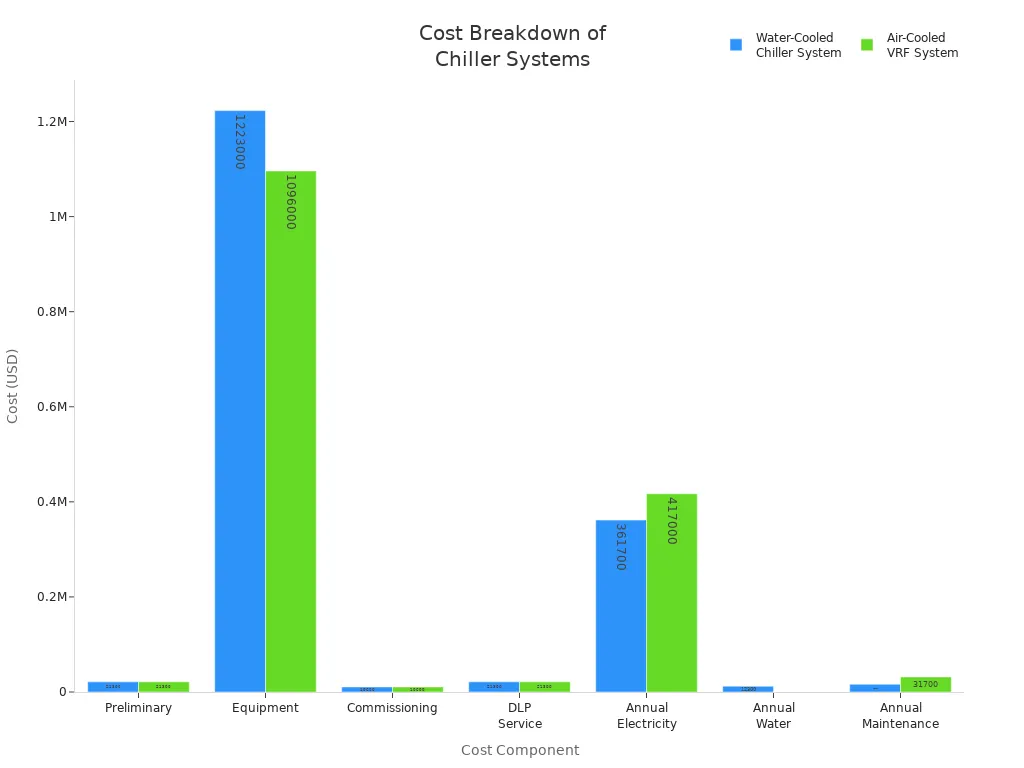
Note: Water-cooled chillers cost more at first but save money on electricity and maintenance. Air-cooled systems cost less to buy but may cost more to run each year. Always look at the total cost, not just the price tag.
Make Your Selection
Final Checklist
You’ve made it this far. Now, you want to make sure you’re ready to pick the best water chiller for your setup. A checklist helps you stay organized and avoid missing anything important. Here’s a simple list you can use before you buy:
Know your cooling needs
Write down what you need to cool and how much heat you need to remove.Pick the right type
Decide if you need an air-cooled or water-cooled chiller. Choose industrial or standard based on your job.Check cooling capacity
Make sure the chiller matches your heat load and flow rate.Review key features
Look for energy efficiency, quiet operation, strong pump performance, and easy maintenance.Compare brands and models
Use your notes to compare options. Check for reliability and good customer service.Read user reviews
See what other buyers say about the chiller’s performance and durability.Plan for installation
Measure your space and check power needs. Make sure the chiller fits your environment.Budget for costs
Look at both the price to buy and the cost to run the chiller each year.
Tip: Keep this checklist handy. It helps you talk to suppliers and makes your decision easier.
Confident Decision
You want to feel sure about your choice. When you follow a step-by-step process, you see your needs clearly. You learn what matters most for your cooling system. You check product quality and read what other users say. This way, you spot brands that care about water safety and reliability.
A systematic approach gives you peace of mind. You know you’ve looked at every detail. You avoid surprises and pick a water chiller that fits your job. You save money, use less energy, and keep your equipment safe.
😊 Ready to make your purchase? Trust your checklist and your research. You’re set to choose a water chiller that works for you and lasts for years.
You’ve learned how to pick the right water chiller for your cold plunge setup. Here are the key steps:
Figure out your cold plunge application.
Size your chiller for the cold plunge heat load.
Choose the best location for your cold plunge chiller.
Check safety for your cold plunge area.
Make sure your cold plunge stays at the right temperature.
Pick the right cooling fluid for your cold plunge.
Match voltage for your cold plunge system.
Plan your cold plunge budget.
A systematic approach helps your cold plunge run efficiently and reliably. You save money and keep your cold plunge working well. If you need help, ask an expert or use special tools for cold plunge sizing.