

If you have allergies and use air conditioning, you need good air purifiers. Some of the best are Coway Airmega AP-1512HH Mighty, Coway Airmega 400s, AirDoctor, and Honeywell HPA300. Experts and Consumer Reports say these models trap allergens well. These machines help you breathe better at home. They also make it easier if you have trouble breathing. Here is how they work with your AC:
Upgrading your HVAC filter catches big pieces of debris.
Air purifiers get rid of tiny particles, mold, and pollen.
Both help control allergy and air conditioning problems.
Allergy and Air Conditioning: Why Air Purifiers Matter

How AC Circulates Allergens
You may think your air conditioning keeps your house clean. But it can actually move allergens around your home. When you turn on your AC, it takes air from your rooms. Then it cools the air and sends it back out. This spreads dust mites, pet dander, mold spores, and cockroach particles everywhere. Studies show air conditioning systems can catch dust mite allergens in their filters. But when the AC runs, these allergens can go back into your air. If you spend a lot of time inside, you breathe in these airborne contaminants and airborne pollutants every day.
Here’s a quick look at the most common allergens found in homes with air conditioning:
Allergen | Description | Prevalence in Homes |
|---|---|---|
Dust Mites | Cause allergic reactions in most homes. | 80% |
Pet Dander | Comes from cats and dogs, affects air quality. | 60% |
Mold | Grows in damp places like bathrooms and basements. | N/A |
Cockroaches | Common in cities, can trigger allergies. | N/A |
Humidity control is important because too much moisture helps mold and dust mites grow. If you do not control humidity, your AC might make things worse.
Benefits of Air Purifiers for Allergies
Using air purifiers with your AC helps a lot with allergies. Regular AC filters catch big particles. But they miss smaller airborne contaminants, airborne pollutants, and airborne pathogens. Good air purifiers for allergies use true HEPA filters and uv-c light technology. These can trap tiny particles, bacteria, and even some viruses.
Here’s what you get when you use air purifiers for allergies:
They catch particles as small as 0.3 microns and help with indoor air quality.
They help control humidity, so mold and dust mites do not grow as much.
They use uv-c light technology to kill airborne pathogens and work better.
Some models have air quality sensors that tell you when your air needs cleaning.
If you use and clean them often, they work better for allergy relief.
You want air purifiers that work well with your AC. Look for models with uv-c light technology, air quality sensors, and good humidity control. These features help you fight allergies and make it easier to breathe every day.
Buying Guide: Air Purifiers for Allergies
True HEPA Filters Explained
When you shop for air purifiers for allergies, always check for a true hepa filter. This filter captures 99.97% of particles as small as 0.3 microns. That means it traps pollen, pet dander, dust mite debris, and mold spores. A hepa air purifier with a true hepa filter works better than regular filters or high-efficiency particulate air filters. You get cleaner air and fewer allergy symptoms.
Tip: Multi-stage filtration systems often combine a true hepa filter with other layers, like activated carbon, for even better results.
Air Changes per Hour & Noise Levels
You want your air purifiers to clean the air fast. Look for a high cadr air purifier with at least 4.8 air changes per hour (ACH). If you have severe allergies, aim for 6 ACH. This means your air gets cleaned every 10 minutes. Testing air purifiers for noise is also important. Try to pick models that run under 45 decibels. Quiet air purifiers help you sleep better at night.
Room Size & AC Compatibility
Choose air purifiers for allergies that match your room size. For best results, the clean air delivery rate (CADR) should be about two-thirds of your room’s square footage. For example, a 150-square-foot room needs a CADR of at least 100. In bigger spaces, like a 450-square-foot living room, look for a high cadr air purifier with a CADR of 300 or more. Your AC system can help, but a hepa air purifier gives extra protection.
Filter Replacement & Maintenance
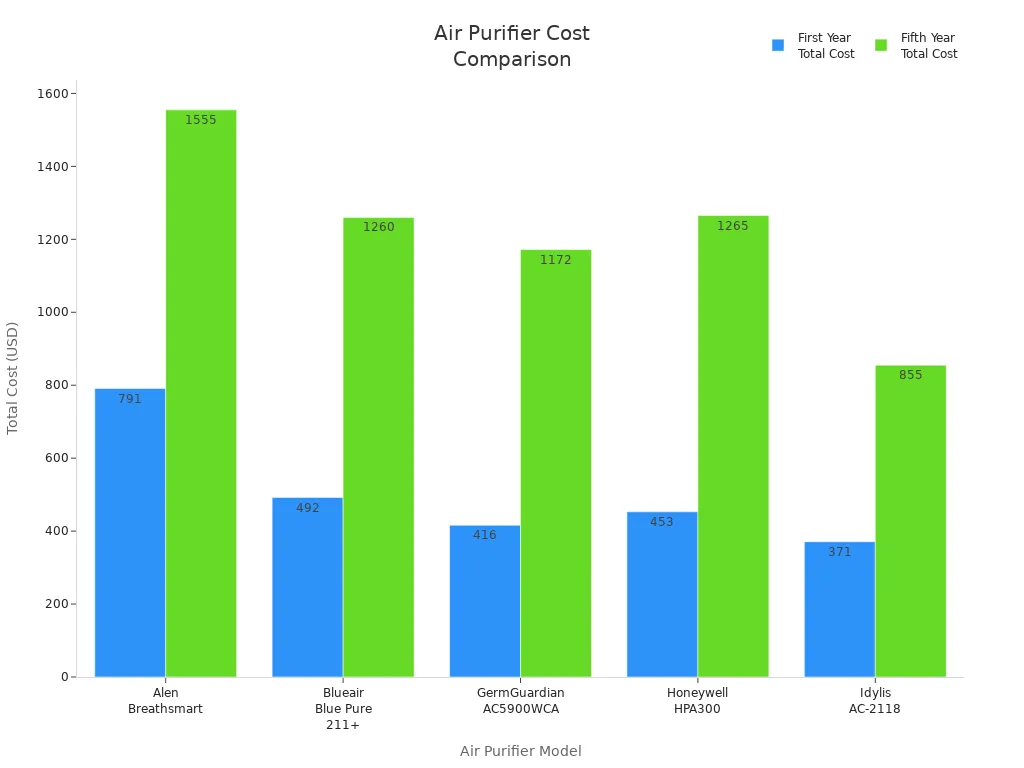
You need to replace your true hepa filter often to keep your air purifiers working well. Costs can add up, so check the price and how often you need new filters. Here’s a quick look at some popular models:
Model | Price | Annual Energy Cost | Filter Cost | Total, First Year | Total, Fifth Year |
|---|---|---|---|---|---|
Honeywell HPA300 | $250 | $76 | $127 | $453 | $1,265 |
Blueair Blue Pure 211+ | $300 | $52 | $140 | $492 | $1,260 |
GermGuardian AC5900WCA | $185 | $56 | $175 | $416 | $1,172 |
Note: Some new air purifiers use AHPCO technology or negative ions for extra allergy relief, but a true hepa filter remains the gold standard for most homes.
Best Performing Air Purifiers for Allergies
If you want the best air purifiers for allergies, you need models that work fast, run quietly, and fit your space. Let’s break down the top picks so you can find the best performing air purifiers for your home.
Coway Airmega AP-1512HH Mighty
You’ll love how quickly this high-quality air purifier cleans your air. The Coway Airmega AP-1512HH Mighty stands out for allergy relief. Here’s why:
It clears a room in just 26 minutes, even with heavy pollution.
It reaches PM1 zero in 29 minutes without the ionizer, so you get strong cleaning without extra features.
The dust CADR is 247 CFM, which is impressive for a unit under $250.
This model gives you excellent value for allergy sufferers. You can use it in bedrooms, living rooms, or offices. It’s quiet enough for sleep and strong enough for pet dander, pollen, and dust. You get the best performance without breaking the bank.
Tip: If you want a reliable, affordable option that handles most allergy triggers, this is a smart pick.
Coway Airmega 400s
If you have a big space or open floor plan, the Coway Airmega 400s is one of the best air purifiers for allergies. Check out the pros and cons:
Pros | Cons |
|---|---|
Excels in large spaces | High operating cost |
Powerful purifying | Bulky |
Extensive control options | App required for some features |
Great noise to power ratio | Hefty investment |
You can control this air purifier with buttons or an app. The air sensor checks your air and turns on the filter when needed. It has one of the highest CADR ratings in its class, so it works fast. If you want smart features and need to clean a large room, this model is a top choice.
AirDoctor
AirDoctor is a favorite for allergy sufferers who want the best air purifiers for allergies with quiet operation. You get an UltraHEPA filter that traps particles as small as .003 microns. That’s much smaller than most HEPA filters catch. The three-stage filtration system removes dust, pollen, and even ultra-fine particles.
You’ll notice it runs about 30% quieter than other air purifiers. This makes it perfect for bedrooms or nurseries. Many users say their allergy symptoms drop, even with pets or during pollen season. If you want peace and clean air, AirDoctor delivers.
Honeywell HPA300
The Honeywell HPA300 is one of the best air purifiers for allergies, especially if you have pets or a large room. Here’s what you get:
Reduces odors and runs quietly.
Filter replacement is easy, with a reminder light.
Captures up to 99.97% of airborne allergens and particles.
Works for rooms up to 465 sq. ft. with 4.8 air changes per hour.
Handles dust, smoke, pollen, pet dander, and mold spores.
You’ll find this model easy to maintain. It’s a great fit for living rooms, family rooms, or any space where you want strong allergy relief. If you want one of the best air purifiers for allergies that’s simple to use, this is a solid pick.
Note: All these models offer strong support and warranties, so you can buy with confidence.
If you want the best air purifiers for allergies, these four models deliver fast cleaning, quiet operation, and easy maintenance. You can breathe easier and enjoy your home, even during allergy season.
Air Purifiers for Mold and Dust

Mold Spore Removal
Mold can make your allergies worse, especially if you use air conditioning. You might not see mold spores, but they float in the air and get into your nose and lungs. That’s why you need air purifiers for mold. These machines pull in the air, trap mold spores, and help with mold removal. True HEPA filters work best because they catch 99.97% of tiny particles, including mold spores as small as 0.3 microns.
Some air purifiers for mold go even further. For example, the Air Oasis iAdaptAir® model showed amazing results in lab tests. It removed 99.9% of Aspergillus niger mold spores in just 10 minutes on high. That’s a huge help if you want fast mold removal. You should look for air purifiers for mold with high CADR ratings. These clean the air quickly and keep your home safe.
Tip: Place your air purifiers for mold near damp areas like bathrooms or basements. This helps stop mold before it spreads.
Dust and Pet Dander Control
Dust and pet dander can make you sneeze and feel stuffed up. Air purifiers for mold also help with these problems. You want a model with a high Clean Air Delivery Rate (CADR). The higher the CADR, the better the air purifier works for dust and pet dander. The best air purifiers for allergies have a dust CADR up to 400. This means they remove dust and pet dander fast, even if you run your AC all day.
Here’s what you should look for in air purifiers for mold and dust:
True HEPA filters for strong mold removal and dust control
High CADR ratings for quick cleaning
Multi-stage filters with activated carbon for extra protection
Allergists say these features matter. True HEPA filters trap almost all allergens. High CADR means your air gets clean faster. Activated carbon filters remove bad smells and gases. If you want fewer allergy symptoms, pick air purifiers for allergies with these features. You’ll breathe easier and feel better at home.
Comparison Table: Air Purifiers for Allergies
Choosing the right air purifier can feel tricky. You want something that fits your space, works quietly, and keeps your allergies under control. Let’s break down the top models so you can see how they stack up. You’ll find details like filter type, CADR (Clean Air Delivery Rate), air changes per hour, noise level, room size, and price. This way, you can pick the best one for your needs.
Manufacturer | Model | Filter Type | CADR (CFM) | Air Changes/Hour | Noise Level (dBA) | Room Size (sq. ft.) | Price (Amazon) |
|---|---|---|---|---|---|---|---|
Levoit | Core 400S | True HEPA | 260 | 5 | 41.4 – 63.5 | 403 | $175.99 |
Coway | AP-1512HH | True HEPA | 233 | 4.8 | 40.3 – 60.9 | 361 | $129.99 |
Coway | Airmega 150 | True HEPA | 152.8 | 3.5 | 40.1 – 59.2 | 237 | $118.20 |
Blueair | 211+ | Particle/Carbon | 350 | 5.5 | 20.3 – 51.0 | 540 | $139.99 |
Coway | Airmega 100 | True HEPA | 109 | 2.8 | 27 – 59.8 | 169 | $119.99 |
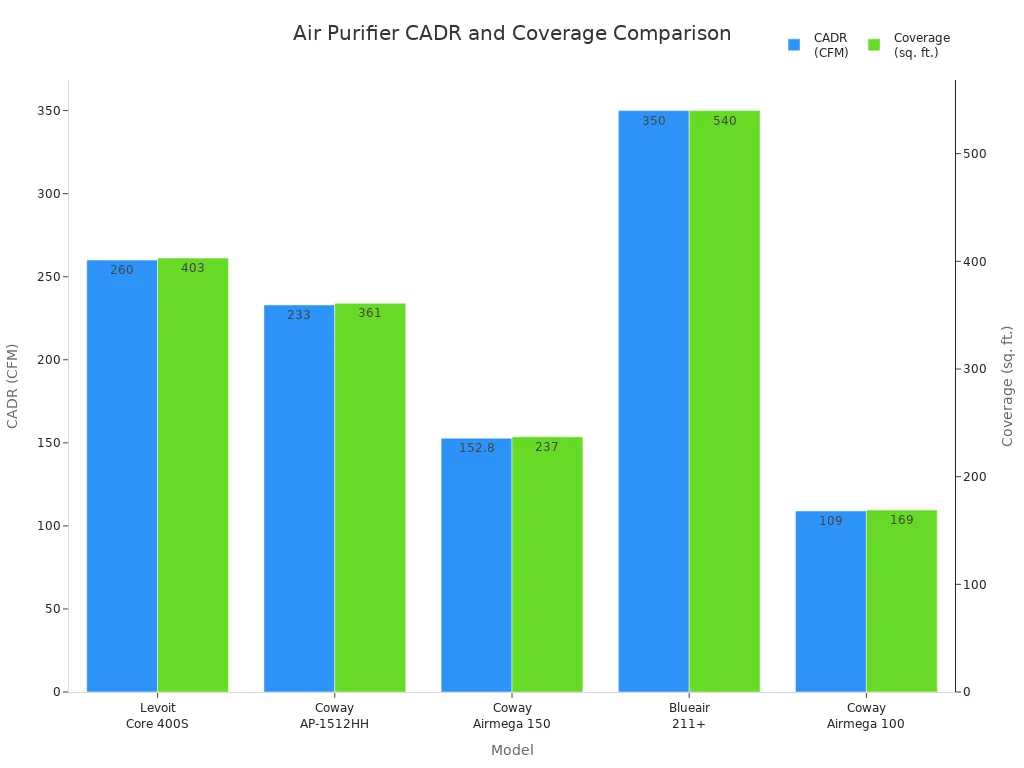
You might wonder how these specs help you. CADR tells you how fast the purifier cleans the air. Higher numbers mean quicker results. If you have a big room, look for a model with a high CADR and coverage. Noise level matters if you want to sleep or study without distractions. Some models run quietly, so you barely notice them.
Don’t forget about filter type. True HEPA filters trap tiny allergens like dust, pollen, and mold spores. If you want extra odor control, pick a model with activated carbon. You should also check if your air purifier has an air quality monitor. This feature lets you see how clean your air is and helps you know when to run the purifier. Some air purifiers even adjust their speed based on what the air quality monitor detects.
If you have allergies, you’ll want to place your air purifier near where you spend the most time. Use an air quality monitor to check different rooms. You can move your purifier if you see the air isn’t clean enough. This way, you get the best results and breathe easier every day.
Tip: Always check the price and filter replacement costs before you buy. Some models cost less up front but need expensive filters later.
You want the best air purifiers for allergy relief with air conditioning. Top brands like Coway, AirDoctor, and Honeywell are great choices. They have strong HEPA filters and clean air quickly. Here are some expert tips to help you use your purifier:
Strategy | Description |
|---|---|
Buy good air purifiers | Put HEPA filters in main rooms to control allergens. |
Keep windows shut | Close windows when pollen or smoke is high outside. |
Use top air filters | Change HVAC filters often to keep air clean. |
Try a whole-house purifier | Use a whole-house purifier for relief in every room. |
Put your purifier in the middle of the room, a few feet up, and close to things that cause allergies.
Change or clean filters every 1 to 3 months. Dirty filters can make allergies worse.
Read expert reviews before buying. The right purifier helps you breathe better every day.